How to Clean Metal Shelves
As an Amazon Associate we earn from qualifying purchases.
How to clean metal shelves starts with the finish on the metal, not the dirt on top of it. Between them, the pages we opened from Metro, a powder-coating maker and the American Galvanizers Association describe one routine: mild soap or detergent, a soft cloth or nylon brush, a clean-water rinse and a full dry. They share warnings against abrasive materials and stiff brushes, and the galvanizing page adds strong acids. This guide turns those pages into a short routine, adds the EPA rules for mold on hard surfaces, and flags where the pages do not cover home shelving.
Quick answer
- Wash with water and a mild detergent, then rinse with clean water and wipe the shelf dry.
- Use a soft nylon brush or a cloth. Keep steel wool, scrapers and stiff brushes away from the coating.
- Match the cleaner to the finish. Chrome, epoxy, powder coat and galvanized steel each have their own warnings.
- In a damp room, treat moisture as the real problem. The EPA says the key to mold control is moisture control.
Know the finish before you pick a cleaner
Metal shelves come with several coatings, and the label or manual may be the only place that names yours. The table lists what each page we opened says about the finish it covers. A page about one finish does not speak for another, so use the row that matches your unit.
| Finish or part | What the page says | Page |
|---|---|---|
| Epoxy-coated steel | Clean with mild detergents, using cleaners recommended for epoxy-coated steel. Abrasive materials, stiff brushes and scrapers are named as things to avoid, and so is physical damage that breaks the coating. | Metro |
| Chrome and stainless steel | Clean with water and mild detergents only. Abrasive materials, stiff brushes and scrapers are named as things to avoid. | Metro |
| Powder-coated steel | Soft nylon brush, mild soap or detergent, clean-water rinse, soft-cloth dry. Never use abrasive cleaners, brushes or steel wool. | Reliance Foundry |
| Galvanized steel | Rinse with water and use a nylon bristle brush if needed. Strong acids attack the coating. | American Galvanizers Association |
| Laminate deck | Damp cloth or sponge with mild soap or detergent. Steel wool and abrasive pads damage laminate. | Wilsonart care sheet |
| Particleboard deck | Not covered by any page we opened | None |
Metro adds a rule for its own finishes: use only cleaners recommended for the finish, and follow any special instructions from the cleaner’s maker. The same caution is sensible for any finish. If you cannot name the finish, start with the mildest option, which is water with a little mild detergent.
What you need
- Mild dish-type detergent and clean water.
- A soft nylon brush and two soft cloths, one for washing and one for drying.
- Gloves. The Edsal manual says to wear gloves when working with metal parts, and household rubber gloves suit water with a mild detergent, according to the EPA.
- A second person if the unit has to move. The Edsal manual says to use two or more people to assemble and move the unit.
Leave abrasive pads, wire brushes and scrapers in the drawer. For the powder-coat row, Reliance Foundry says to never use abrasive cleaners, brushes or steel wool, and the Metro pages name abrasive materials, stiff brushes and scrapers as things to avoid.
Step by step: the basic routine
- Empty the shelf. Take off every item, and move the unit only with help. You cannot clean the surface under the items while they are on it.
- Dust first. A WebStaurantStore-hosted assembly sheet says to dust the shelf or wipe it down with a damp cloth or paper towel to clean off any dirt or debris. Reliance Foundry says to use a soft nylon brush to remove accumulated dirt.
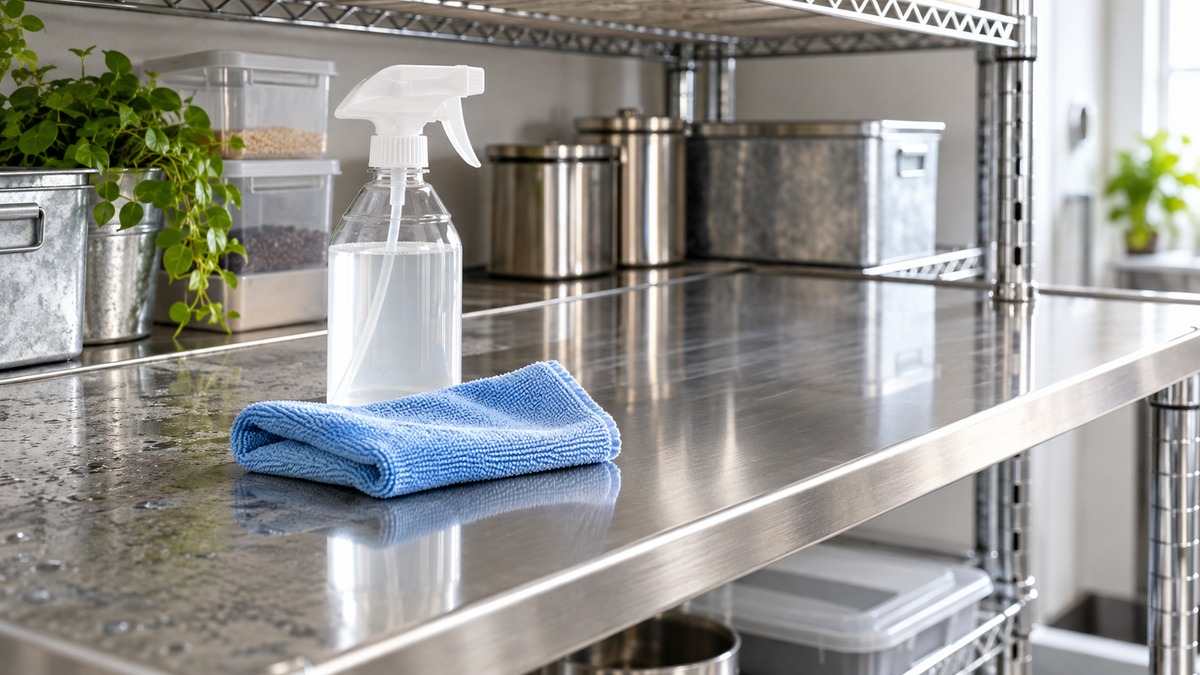
- Wash. Wipe the shelf with a cloth wrung out in water and mild detergent. Both the Metro and Reliance Foundry pages recommend mild detergents.
- Work on stuck spots gently. Use the nylon brush on the spot. The galvanizing association says a nylon bristle brush can be used if necessary.
- Rinse. Reliance Foundry says to rinse in clean water and not to let the cleaning solution dry on the surface.
- Dry. Wipe the shelf dry with a soft cloth. The EPA tells owners to dry hard surfaces completely after scrubbing.
- Inspect while the shelf is empty. Look for loose or missing parts and for chipped coating. The same Reliance Foundry sheet says to tighten or replace loose or missing parts immediately.
Wire shelves and open decks
The assembly sheet we opened for wire shelving says not to use harsh chemicals on the shelving when cleaning. The Advance Tabco wire shelving sheet goes further and says the maker does not recommend use for activities employing harsh and active chemicals.
The same WebStaurantStore-hosted sheet gives a placement tip that bears on cleaning: “place epoxy in moist environments, chrome in dry environments”. If you keep a chrome unit in a damp basement or laundry room, you are working against that tip. Moisture is also the main driver of mold, which we cover below. If you want a cover that keeps spills off an open wire deck, see our page on wire shelf covers, and for freestanding wire units see free standing wire shelves for the kitchen.
If the shelves are galvanized
The American Galvanizers Association page is written for hot-dip galvanized steel articles, not for shelving, so use it as a guide to the coating rather than to your exact unit. It says dirt or mud rinses off with water. For a medium wet-storage stain, it gives a mild ammonia solution of 1 part ammonia to 10 parts fresh water and a nylon brush. It warns that stronger acids such as hydrochloric, sulfuric or muriatic acid attack the coating. After using ammonia or acid, it says to rinse the surface with plenty of fresh water immediately and let it dry thoroughly.
That ammonia step meets an EPA warning head on. The EPA says to never mix chlorine bleach solution with cleaning solutions or detergents that contain ammonia, because toxic fumes could be produced. If you use the ammonia solution, keep bleach out of the bucket, off the cloth and out of the room.
Laminate and particleboard decks
Some freestanding units pair a steel frame with a laminate or particleboard deck. The Edsal 5-shelf manual we opened is for units with particleboard shelves. The Wilsonart sheet says the routine care for laminate is a damp cloth or sponge with a mild soap or detergent. It warns that acidic or abrasive cleaners can damage laminate and that steel wool and abrasive pads will damage it. It also warns that rust removers contain harsh chemicals that cause permanent damage and says to wipe off any spill at once.
That last point matters for a metal-frame unit. If you treat a rusty post, keep the rust remover off the deck. The sheet is about laminate only. No page we opened covers particleboard, so keep water on a particleboard deck to a minimum and dry it straight away; that is our own caution, not a sourced rule.
Rust spots and chipped coating
The pages we opened do not give a household method for removing rust from bare steel shelves. What they give is a repair path for coated steel, and a clear signal about when to stop using a unit. The Reliance Foundry sheet covers minor scrapes in powder coating. It says to scuff the damaged area gently with sandpaper, make sure all signs of rust are removed, apply an exterior metal primer to the scuffed area, and then apply matching enamel. It adds: “Exact color match may not be possible.”
The same sheet says larger scratches, where the coating has torn off, may need re-coating or replacement. It also says to remove any significant rust as soon as possible and to take heavily damaged products out of service until they are repaired. Metro names physical damage that ruptures the coating as a problem in its cleaning guidelines. For a shelf, a rusted joint or post is a structural question as well as a cosmetic one, and the sheets do not set a threshold for when to replace a unit.
Damp rooms and mold
In a garage, basement or laundry room, moisture deserves as much attention as the cleaner. The EPA brief guide says: “The key to mold control is moisture control.” It says to dry water-damaged areas and items within 24 to 48 hours, and to keep indoor humidity below 60 percent, ideally between 30 and 50 percent. It says that if you clean up mold but do not fix the water problem, the mold will most likely come back.
For mold on a hard surface such as a steel shelf, the EPA says to scrub it off with detergent and water and dry completely. It says that chlorine bleach is not recommended as a routine practice during mold cleanup. For protection it lists gloves, goggles without ventilation holes and an N-95 respirator, and notes that household rubber gloves are enough with water and a mild detergent. Its size rule is that a moldy area under about 10 square feet, roughly a 3-foot-by-3-foot patch, can usually be handled by the owner. The table turns that rule into shelf sizes.
The sizes below come from the Edsal 5-shelf manual. The area of a deck in square feet is its width times its depth, divided by 144. The last column divides 10 by that area. The EPA figure refers to the moldy patch, not the deck, so the last column shows only how much shelf surface equals the threshold.
| Deck size (inches) | Area | Square feet | Decks to reach 10 square feet |
|---|---|---|---|
| 30 × 12 | 30 × 12 = 360 sq in | 360 ÷ 144 = 2.5 | 10 ÷ 2.5 = 4.0 |
| 36 × 18 | 36 × 18 = 648 sq in | 648 ÷ 144 = 4.5 | 10 ÷ 4.5 = 2.2 |
| 48 × 18 | 48 × 18 = 864 sq in | 864 ÷ 144 = 6.0 | 10 ÷ 6.0 = 1.7 |
| 48 × 24 | 48 × 24 = 1,152 sq in | 1,152 ÷ 144 = 8.0 | 10 ÷ 8.0 = 1.3 |
If mold growth covers more than 10 square feet, or if there has been a lot of water damage, the EPA points to its guide for schools and commercial buildings, which it says applies to other building types too.
How often to clean
Reliance Foundry says to perform routine inspection and cleaning every 6 months, and more often in places with high salt or heavy particulates. Twelve months divided by 6 gives 2 cleanings a year as a starting point. That is a rule for its own products. No page we opened sets a schedule for household shelves, so adjust it to the room. Set the interval by the room, and use the EPA’s humidity range as the guide for a damp space.
How we chose
This is a method guide, not a product list. We opened ten pages on 2026-10-21: two Metro cleaning documents, one powder-coat care sheet, one galvanizing association page, two EPA pages, two wire-shelf assembly sheets, one Edsal manual and one laminate care sheet. We kept statements that the pages make in plain words, and every quoted phrase was matched to the extracted text of its page. Metro prints its cleaning guidelines inside a corrosion document, and only the cleaning instructions from it are cited here. The table figures are our own arithmetic.
Mistakes to avoid
- Scrubbing with steel wool or a stiff brush. The Metro and Reliance Foundry pages name these as things to avoid.
- Letting the cleaning solution dry on the shelf. Reliance Foundry says not to let it dry on the surface.
- Using a strong acid on galvanized steel. The galvanizing association says strong acids attack the coating.
- Mixing bleach with ammonia. The EPA warns that toxic fumes could be produced.
- Dripping rust remover on a laminate deck. The Wilsonart sheet says rust removers cause permanent damage to laminate.
- Cleaning a damp unit and putting it back in a damp room. The EPA ties mold to moisture, so dry the shelf and check the room.
What we could not verify
The pages we opened do not give a household rust-removal method for bare steel shelves; the university extension rust page we located returned an access block, so none is cited. The Reliance Foundry sheet is written for outdoor site furnishings, not for shelving, and the galvanizing association page is written for galvanized steel articles in general. Neither names a shelf model. The Metro documents cover Metro finishes only, and Edsal and Muscle Rack publish no cleaning page that we found. No page covers particleboard decks, a cleaning interval for household shelves, or how to tell what finish a shelf has. The pages also do not say which cleaner brands are safe for each coating.
Frequently asked questions
Can I use bleach to clean metal shelves?
The EPA does not recommend chlorine bleach as a routine practice for mold cleanup, and the Metro pages tell owners to use mild detergents. If you do use bleach, never mix it with any product that contains ammonia, as the EPA warns that toxic fumes could result.
What is the safest cleaner for chrome shelving?
Metro’s page for chrome, Super Brite, epoxy and stainless finishes says products must be cleaned with water and mild detergents only. That page gives no other cleaning method for chrome, so a mild dish-type detergent in water is the starting point.
Can I use steel wool on a rusty shelf?
For powder-coated steel, Reliance Foundry says never to use steel wool, and the Metro pages name abrasive materials as a hazard to the coating. For minor rust under a coating, Reliance Foundry describes gentle scuffing with sandpaper, a primer and matching enamel.
How do I clean galvanized metal shelves?
Start with a rinse and a nylon bristle brush, which is the first step in the association’s page on dirt. For wet-storage stains it gives a mild ammonia solution at 1 part ammonia to 10 parts fresh water, then a rinse and a full dry.
Why do my metal shelves keep getting mold or rust spots?
Moisture is the usual cause. The EPA says mold needs moisture, and the Reliance Foundry sheet tells owners to fix coating damage and remove significant rust early. Check the room’s humidity against the EPA’s range of 30 to 50 percent.
Bottom line
Match the cleaner to the finish, start with water and mild detergent, rinse, dry completely, and fix the moisture if mold or rust returns.
Sources
- https://res.katom.com/products/001/001-PR2454NK3/001-PR2454NK3_warranty.pdf (opened 2026-10-21)
- https://gotopac.com/mwdownloads/download/link/id/2079 (opened 2026-10-21)
- https://www.reliance-foundry.com/wp-content/uploads/powder-coating-care-and-maintenance.pdf (opened 2026-10-21)
- https://galvanizeit.org/knowledgebase/article/cleaning-hot-dip-galvanized-steel (opened 2026-10-21)
- https://www.epa.gov/mold/mold-cleanup-your-home (opened 2026-10-21)
- https://www.epa.gov/mold/brief-guide-mold-moisture-and-your-home (opened 2026-10-21)
- https://argo.webstaurantstore.com/documents/pdf/wire_shelving_installation_guide.pdf (opened 2026-10-21)
- https://cdn.restaurantsupply.com/pdf/w/i/r/wireshelving.pdf (opened 2026-10-21)
- https://images.thdstatic.com/catalog/pdfImages/78/78b66fe2-2d37-462c-b8a0-9e99ae1bde19.pdf (opened 2026-10-21)
- https://pdf.lowes.com/useandcareguides/688598215633_use.pdf (opened 2026-10-21)
As an Amazon Associate we earn from qualifying purchases.