How to Store Vinyl Records on a Shelf
As an Amazon Associate we earn from qualifying purchases.
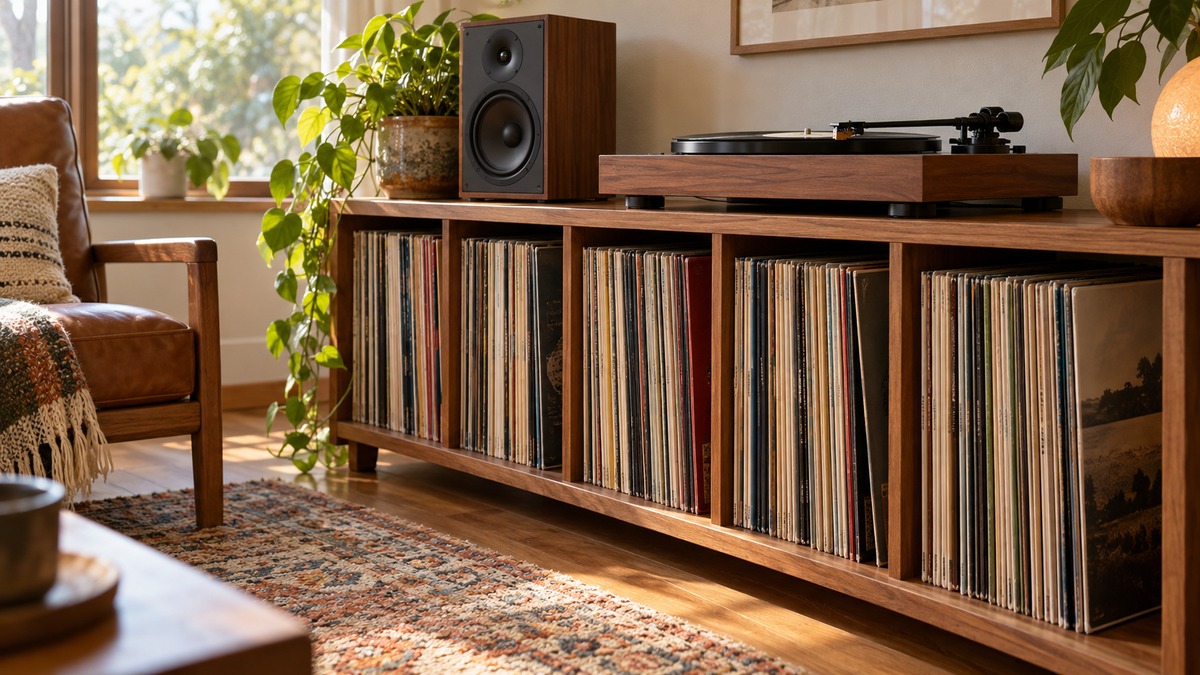
How to store vinyl records on a shelf comes down to five checks: stand the records on edge, keep similar sizes together, support them with dividers, make sure the shelf can carry the weight, and put the shelf in a stable room. The Library of Congress, the National Archives, the University of Illinois and the Provincial Archives of Alberta all point the same way on the first check. This guide turns their advice into a setup plan, with arithmetic you can run on your own shelf.
Quick answer
- Stand records upright on their edges, inside their sleeves, and do not stack them.
- Put dividers about every 4 to 6 inches so each section supports the records beside it.
- Plan for at least 35 pounds per foot of shelf, a figure from the Library of Congress, and check the shelf maker’s own rating.
- Keep the shelf out of attics and garages, away from radiators and vents, and out of direct light.
Stand the records on edge and do not stack them
Every source we opened that addresses orientation agrees. The Library of Congress says to store all formats upright, with discs on edge. The National Archives says to shelve discs such as LPs, 45s and 78s “vertically and in their sleeves/albums.” Its next sentence is the shortest rule on the page: “Do not stack discs on top of one another.” The Illinois preservation program says “Never store phono records stacked.”
The University of Cincinnati preservation lab gives the reason in plain terms. Its conservators write that when discs sit on top of each other, “their collective weight can compound quickly,” and that the weight can slowly compress the grooves of the discs underneath. A record on the bottom of a pile carries every record above it. A record on edge carries only itself, as long as its neighbors are held upright too.
That last condition is the one most shelves fail. Records standing on edge still need something to lean on. The Illinois program says grooved discs are heavy and can exert pressure and warp “if too many discs are shelved together at an angle without dividers.” So the shelf rule has two parts: stand the records up, and stop them from leaning into one long diagonal row.
Divide the shelf into sections
The Library of Congress asks for sturdy, immovable dividers every 4 to 6 inches that support the whole face of the disc in its sleeve. The Illinois program words it as full-height and full-depth dividers spaced 4 to 6 inches apart, secured at the top and bottom. Both agree on the spacing. The Illinois program also explains the goal: to spread the pressure and weight of the discs evenly.
The Alberta provincial archives table for grooved audio discs adds a related instruction: “Store vertically and pack snugly to avoid warping.” Snug and divided do not conflict, in our reading. A narrow section filled from side to side matches the Alberta wording, and the Illinois warning about discs at an angle points to the same risk in a long row with no dividers.
The table below turns the 4 to 6 inch spacing into a divider count. The method is simple. Divide the shelf width by the spacing to get the number of sections, then subtract one to get the dividers needed inside the shelf, because the shelf ends act as the outer walls. We rounded up wherever the division left a fraction, so every section is no wider than the spacing.
| Shelf width (inches) | Sections at 6 inches | Dividers inside at 6 inches | Sections at 4 inches | Dividers inside at 4 inches |
|---|---|---|---|---|
| 24 | 24 ÷ 6 = 4 | 4 − 1 = 3 | 24 ÷ 4 = 6 | 6 − 1 = 5 |
| 30 | 30 ÷ 6 = 5 | 5 − 1 = 4 | 30 ÷ 4 = 7.5, so 8 | 8 − 1 = 7 |
| 36 | 36 ÷ 6 = 6 | 6 − 1 = 5 | 36 ÷ 4 = 9 | 9 − 1 = 8 |
| 48 | 48 ÷ 6 = 8 | 8 − 1 = 7 | 48 ÷ 4 = 12 | 12 − 1 = 11 |
For a shelf you already own, pick a spacing inside the 4 to 6 inch band and keep it the same across the shelf. If your shelf has fixed slots for shelf dividers, compare the slot spacing with the table. For divider options, see our roundup of shelf dividers.
Check that the shelf can carry the load
This is the check people skip, and the Library of Congress states it first. Its guidance says shelving must be sturdy enough to support the heft and weight concentration of audio materials, and that grooved discs average “35+ pounds per shelf-foot.” It also warns that all formats concentrate their weight on the centerline of a shelf, and that this can cause some shelving to collapse.
The figure is a floor, not a ceiling, because the guide writes 35 plus. The table multiplies it by shelf length in feet. The method: shelf width in inches divided by 12 gives feet, and feet times 35 gives the minimum weight in pounds to plan for on a fully loaded shelf.
| Shelf width (inches) | Shelf length (feet) | Weight to plan for, minimum (pounds) |
|---|---|---|
| 24 | 24 ÷ 12 = 2.0 | 2.0 × 35 = 70.0 |
| 30 | 30 ÷ 12 = 2.5 | 2.5 × 35 = 87.5 |
| 36 | 36 ÷ 12 = 3.0 | 3.0 × 35 = 105.0 |
| 48 | 48 ÷ 12 = 4.0 | 4.0 × 35 = 140.0 |
Compare the right-hand column with the weight rating the shelf’s maker states for a single shelf, if it states one. The sources we opened do not give a rating for any common home shelf, so the comparison has to come from the maker’s own documents. A shelf that is rated for less than the number in the table, or one that does not state a rating, is a poor fit for a full run of records. The sources do not describe a mounting method or bracket layout for record shelves, so we do not give one here.
Wood or metal?
The Illinois program is direct about furniture for grooved discs: “Wood cabinets should be avoided.” It names “Enameled steel, stainless steel, or anodized aluminum” as preferred materials. The vinyl entry does not state why wood is discouraged, and we do not guess at a reason.
In practice this gives you a ranking to apply to the shelves you can choose from. A metal unit follows the Illinois preference. A wood unit does not, and the sources do not say how much that matters for a record collection kept in sleeves in a stable room. If the only shelf you have is wood, the sleeve and room advice below becomes the more important part of the plan. For metal options, see affordable metal shelves for the home.
Keep sizes together
The Library of Congress gives a short instruction here: “Do not store grooved discs of different diameters together.” The Illinois program says similarly sized discs should be stored together vertically. The pages do not explain the rule. It fits the divider guidance, since dividers are meant to support the face of the disc, but that link is our reading.
The Illinois collection guide lists the common diameters for vinyl as 7, 10 and 12 inches. It describes the 12-inch LP, the 10-inch EP and the 7-inch single, which is played at 45 rpm. Treat each size as its own group on the shelf.
| Format | Typical diameter (Illinois guide) | Shelf rule |
|---|---|---|
| LP | 12 inches | Keep with other 12-inch discs |
| EP | 10 inches | Give it its own section, apart from LPs |
| Single (45) | 7 inches | Give it its own section, apart from LPs |
The sources do not say whether 7-inch records should go on a separate shelf or only in a separate section. The rule they give is about not mixing diameters in the same space. If the unit has a short shelf, use it for the small discs.
Sleeves matter as much as the shelf
The Library of Congress suggests replacing record sleeves with a high density polyethylene sleeve when possible. The Illinois program says the same and gives a rule of thumb: the plastic sleeves it rates as bad are clear and sticky or tacky, while the good ones are frosted and slippery. The Alberta archives table says to use polyethylene or acid-free paper sleeves, not polyvinyl chloride (PVC) sleeves.
The Cincinnati lab adds two points about old covers. Older records often have non-archival plastic outer sleeves that can warp over time, and a warped outer sleeve can lead to the disc warping. The lab also says original cardboard sleeves can encourage mold growth in high humidity, so it advises keeping them separate from the sleeved records, or at least putting the record in a protective inner sleeve before it goes into the cardboard.
The Illinois program adds a step for records that arrive in shrink wrap: remove it, because shrink wrap can keep shrinking and harm the outer sleeve or the record. It also says that if records are kept in a paper binder, they should be taken out and housed in individual sleeves. Together these notes give a quick sort for a new collection: remove old shrink wrap, replace tacky clear sleeves, and keep original cardboard covers apart from the bare discs.
Pick the room before you pick the wall
The National Archives gives the most direct room advice for a home collection. It says audio recordings need stably low temperature, low humidity, and protection from flooding, air pollutants and sunlight. It advises against attics and garages because their climates are not regulated, and it names a closet or an unused room as often good choices. It adds that basements are dark and cool, but their humidity can be high unless it is regulated, and it advises moving to another floor if the basement ever floods.
The Library of Congress adds a few more points for home collections: keep the shelf away from radiators and vents, away from sources of vibration, and away from strong light, with no exposure to direct or intense light. The Illinois program lists high humidity and temperature as conditions that foster mold on discs and covers, and says high temperatures may soften the plastic and warp it. It also names direct sunlight and UV rays as harmful to vinyl.
The National Archives also says to keep materials off the floor, where water damage, insects and rodents are a risk, so the lowest shelf should sit above the floor and not on it.
Temperature and humidity: where the sources disagree
The five sources that give a climate target do not agree on one set of numbers. The table lists each as written, with the audience the source names. One conversion is ours: 14 degrees Celsius times 1.8, plus 32, is 57.2 degrees Fahrenheit.
| Source | Audience | Temperature | Relative humidity |
|---|---|---|---|
| Library of Congress | Home collections | Room temperature or below | About 35 to 40 percent |
| National Archives | Home collections | 55 to 70 °F | 30 to 55 percent |
| Cincinnati preservation lab | Conservation lab guidance | Not stated | 30 to 50 percent, swings within 5 points in 24 hours |
| Alberta provincial archives | Archives guidance | 14 °C (57.2 °F) | 40 percent |
| Illinois preservation program | Collections guidance | 40 to 54 °F ideal | 30 to 50 percent |
Two readings follow from the table. First, 40 percent humidity falls inside every humidity range listed, so it is a defensible target if you own a hygrometer. Second, the temperature figures do not overlap cleanly: the Illinois ideal tops out at 54 °F, while the National Archives range starts at 55 °F. The Illinois program also asks for tight control, allowing only about 2 °F and 5 percent humidity of swing, which suits a managed room and not a bedroom wall. The sources do not say which target is right for a house, so the practical rule is the one they share: stable, cool, relatively dry, and no attics, garages or radiators.
Handle the records the way libraries do
Shelving is only half of storage, since every record is touched twice, once going in and once coming out. The Library of Congress says to handle grooved discs by “the edge and label areas only.” A library guide from Brigham Young University gives the same instruction in its own words: touch only the edge and center label. The Illinois program adds a hand position, about the 3 and 9 o’clock points, so that no stress lands on the disc, and it advises returning each disc to its enclosure instead of leaving it on the player.
For dust, the Library of Congress suggests canned air for grooved discs, and the BYU guide recommends a record cleaning brush or an anti-static microfiber cloth. The Illinois program warns that a dirty record played without cleaning can cause the stylus to drag debris through the grooves. These notes sit beside the shelf plan because dust that lands on a record in storage ends up on the stylus later.
If you see mold on a sleeve or record, treat it with care. The National Archives says to be very cautious with materials you suspect of mold because they can pose a serious health risk. The Illinois program puts it more bluntly, saying mold can be toxic, and advises sealing a moldy item and its container in a bag until a conservator can act.
A setup plan, step by step
- Step 1: choose the room. Pick a closet or an unused room that stays cool and dry, away from radiators, vents, vibration and direct light.
- Step 2: choose the shelf. Prefer metal. Find the maker’s rated capacity per shelf and compare it with the weight table above.
- Step 3: sort by diameter. Group LPs, EPs and singles separately.
- Step 4: fix the sleeves. Remove shrink wrap, replace tacky clear sleeves with high density polyethylene sleeves, and keep original cardboard covers separate from the bare discs.
- Step 5: set the dividers. Space them 4 to 6 inches apart and secure them at the top and bottom.
- Step 6: load the shelf. Stand the records on edge and fill each section snugly, within the shelf’s rated capacity.
- Step 7: handle with care. Hold records by the edges and label, and return each one to its sleeve after playing.
Step 6 puts the load check in the order you will meet it: the rated capacity from the maker has to be known before the first record goes on. For more on this kind of unit, see our guide to record storage.
How we chose
We read each page on 2026-10-21 and kept only the rules a page states in its own words. The core set is the Library of Congress care guide for audio visual materials, the National Archives audio storage guidance, the University of Illinois preservation program pages on vinyl and on grooved discs, a University of Cincinnati preservation lab post, and a provincial archives table from Alberta. A Brigham Young University library guide supplies the handling note. We did not use retailer or manufacturer pages for any load or storage claim, and we left out pages that did not load. The tables are our own arithmetic, and every input is named.
Mistakes to avoid
- Stacking records flat. The National Archives, the Illinois program and the Cincinnati lab all warn against it.
- Leaving a long shelf half empty with no dividers. The Illinois program warns about discs shelved at an angle without dividers.
- Mixing 7-inch singles with 12-inch LPs. The Library of Congress says not to store different diameters together.
- Trusting an unrated shelf. The Library of Congress says weight concentrates on the centerline and can cause shelving to collapse.
- Using the attic or garage. The National Archives advises against places with unregulated climates.
- Using tacky clear sleeves. The Illinois program rates them as bad sleeves.
What we could not verify
The sources we opened do not give a typical width for a sleeved record, so the shelf tables stop at divider counts and weight and do not estimate how many records a shelf holds. They do not give a shelf depth, a fill percentage, a bracket spacing, or a rated capacity for any home shelf. They do not say how long warping takes, and they do not compare one wood shelf with another. The Illinois program says to avoid wood but does not state a reason in the vinyl entry. Most of the guidance is written for libraries and archives, so applying it to a home shelf is an adaptation and not a direct rule. None of the pages names a specific shelf, divider or sleeve product as the right one, and nothing in this guide is a product claim.
Frequently asked questions
Can I stack vinyl records flat?
No. The National Archives says not to stack discs, and the Illinois program says never to store phono records stacked. The Cincinnati lab explains that the weight compounds and can slowly compress the grooves of the discs below.
How far apart should the dividers be?
Between 4 and 6 inches, according to the Library of Congress and the Illinois program. The Illinois program asks for full-height and full-depth dividers secured at the top and bottom. Use the divider table above to turn your shelf width into a count.
Is a wood shelf bad for records?
The Illinois program says wood cabinets should be avoided and prefers enameled steel, stainless steel or anodized aluminum. Its vinyl entry does not state why. If you already own a wood unit, pay close attention to sleeves, climate and cleanliness, which the sources treat as separate risks.
How much weight does a record shelf hold?
Plan for at least 35 pounds per foot of shelf, the Library of Congress average for grooved discs. A 30-inch shelf is 2.5 feet long, so the minimum is 87.5 pounds. The sources do not give a rating for common home shelves, so check the maker’s stated capacity.
Should 7-inch singles go with LPs?
Not in the same section. The Library of Congress says not to store grooved discs of different diameters together, and the Illinois program says to store similarly sized discs together.
What humidity should the room have?
The sources give different ranges. The Library of Congress gives about 35 to 40 percent for home collections, while the National Archives gives 30 to 55 percent. Both include 40 percent, and the National Archives advises against attics and garages because their climates are not regulated.
Bottom line
Stand every record on edge in a sturdy metal shelf divided into 4 to 6 inch sections, and keep the shelf in a cool, dry, interior room.
Sources
- https://www.loc.gov/preservation/care/record.html (opened 2026-10-21)
- https://www.archives.gov/preservation/formats/audio-storage.html (opened 2026-10-21)
- https://psap.library.illinois.edu/collection-id-guide/phonodisc (opened 2026-10-21)
- https://psap.library.illinois.edu/advanced-help/av-phonodisc (opened 2026-10-21)
- https://libapps.libraries.uc.edu/thepreservationlab/2026/06/grooved-disc-media-storage-solutions (opened 2026-10-21)
- https://www.provincialarchives.alberta.ca/sites/default/files/2020-09/Preserving%20Audiovisual%20%26%20Digital.pdf (opened 2026-10-21)
- https://guides.lib.byu.edu/vinylrecords (opened 2026-10-21)