How to Organize Clothes Without a Closet or Dresser
Affiliate disclosure: As an Amazon Associate we earn from qualifying purchases.
How to organize clothes without a closet or dresser comes down to three decisions: how much clothing needs to hang, which room spaces can take a rod or a rack, and which items can live in boxes or bins. The extension material we opened covers that situation directly. A 1967 Oregon State circular lists portable closets, room corners, rods and simple racks, and two Nebraska archive entries describe clothing organization and written planning. This guide works through those ideas with the arithmetic they support, and it marks what the sources leave out, such as load ratings for home-built racks.
Quick answer
- Work out the hanging length first. The Oregon State circular allows at least four feet of rod space per person for hanging clothes.
- Use room corners for boxes or bins at several heights. The circular describes boxes stacked at one side in room corners as shelf areas for caps, hats, shoes and other items.
- Consider a portable closet before anything else. The circular says portable closets come in various sizes and can serve as room dividers.
- Store shoes and boots off the floor, and fold or stack what does not need to hang. Each of those ideas is in the circular, and each needs a measured spot.
Count the hanging length you need
Table 1 turns the circular’s rules into lengths you can compare with the room. The circular gives four feet of rod space for each person who hangs clothes, and four inches of rod space for each coat in a coat closet. A blouse rack holds five blouses in the space one blouse would take. Those three rules cover most of a closet without a closet.
| Item | Rule from the circular | Calculation | Result |
|---|---|---|---|
| One person’s clothes on a rod | 4 ft per person | 1 × 4 ft | 4 feet, or 48 inches |
| Two people’s clothes on a rod | 4 ft per person | 2 × 4 ft | 8 feet, or 96 inches |
| Coats on a rod | 4 in per coat | 12 × 4 in | 48 inches, or 4 feet |
| Blouses on a rack | 5 blouses per blouse-sized space | 15 ÷ 5 | 3 blouse-sized spaces |
The coat count of 12 and the blouse count of 15 are examples, not recommendations. Put your own counts into the same calculation. If the total is longer than the wall you can spare, the next sections show where else the clothes can go.
Use a portable closet or a room corner
The Oregon State circular describes a portable closet as the simplest way to add hanging space in a home. It says portable closets can be bought in various sizes, and that some can be used as room dividers to give privacy in a large room that two or more people share. For a studio or a shared bedroom, a divider-style closet can therefore do two jobs. Measure the wall or floor you plan to use, then match the closet to that footprint, because the circular does not give a size for any particular model.
Room corners are the other option the circular names. Boxes stacked at one side in a corner provide shelf areas at several heights, which the circular suggests for caps, hats, shoes, books, toys and games. Put the heaviest boxes low and keep the higher shelves for out-of-season items, because the circular says those can be kept up high. A corner that is out of the walkway works best. Check the wall it sits against before you load the stack, since the circular says nothing about stacking limits.
If your home has a stairway, the circular describes a closet built under it, or hung above the foot of the stairs to allow plenty of headroom. Apartments usually do not have that space, so treat this option as a house-only idea. For more compact layouts of this kind, see ideas for a bedroom with no closet, and for a whole house without closets, the storage ideas for a house with no closets.
Rods and racks without a closet
A rod does not need a closet. The circular describes a junior rod made from any pole of suitable size and a rope adjusted to the right height, which is a simple way to add hanging space in a bedroom. It also describes a long coat rod suspended from a main clothes pole. Neither description gives a load rating, so match the rod to the clothes you hang and check the fixing before you rely on it.
Use the circular’s 1967 average hanging heights to place a rod. Street dresses and coats average 63 inches. Trousers, suits, blouses and skirts average 39 to 45 inches. Clothes for 5- to 12-year-olds average 45 inches, and clothes for 3- to 5-year-olds average 30 inches. A rod set at a lower height gives short items room, and the space above it can hold a shelf or a basket. The gap between a 63-inch rod and a 39-inch rod is 24 inches, which is the room a shelf would have above a lower rod.
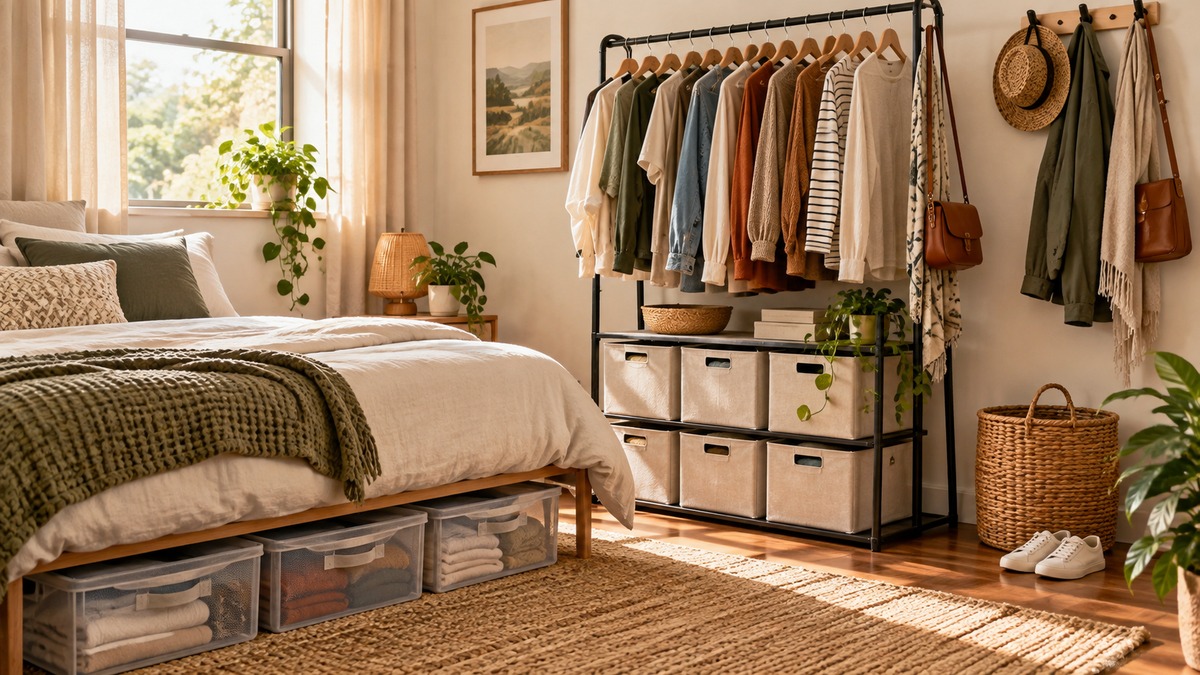
A small clothes rack for a bedroom is one option when a rod cannot be fixed in the room. For a shorter list of options, see small clothes racks for a bedroom, and check the rack’s own sheet before you load it.
Shoes, boots and floor items
The circular describes a slotted wooden rack or a shelf of hardware cloth about 6 inches above the floor for boots and rubbers. It says to put aluminum foil, a plastic sheet or heavy paper below the rack to catch drips. That makes the rack a tray and a shelf in one, and the 6-inch height is the figure to plan around. Shelves at the sides can hold purses, gloves and hats on the same rack.
A shoe rack can also be built from the solid ends of a fruit box, cut sloping at the top and joined by wooden strips, as the circular describes. Plastic or fabric shoe bags can hang on a closet door, but only if the door hinges. A sliding door does not swing, so check the door type before you plan the bags. For shoes on the floor, the small shoe rack for a closet floor is the next read, and for coat and shoe space near the door, see the coat closet shoe storage post.
Replace the dresser with boxes and a chest
A dresser stores folded clothes and keeps them off the floor. Without one, the circular offers two substitutes. The first is a chest of drawers placed under short clothes, which the circular suggests when the rod cannot be changed, to hold miscellaneous items. The second is stacked boxes or shelves in a room corner, described above.
If you plan to add a chest later, the chest of drawers for clothes storage post is the next read, and a short chest suits a space under a rod. The Nebraska archive entry for EC64-434 covers the proper organization of clothing items, with the aim of making storage space go further.
Hats, bags and small items
The circular describes several low-cost holders that use no closet. Ladies’ or men’s hats can be stored on hat stands made from coffee cans or round cereal cartons, covered with shelf paper or foil. An umbrella rack can be built from wood slats attached to a door, and a hat rack above it holds two hats. A rubber covered plate rack stores purses upright on a shelf. Several of these are home-made holders, and the circular gives no load figure for any of them.
Small items that do not need to hang can go in labeled bins on a shelf. The bins should be sized to the items they hold, and the items you reach most often should sit at the front. This is a planning choice rather than a figure from the sources.
Write a list before you buy anything
The Nebraska archive entry for EC476, Planning the Family Wardrobe, suggests a written plan and a spreadsheet to track what a household has and what it needs. Use that method here. List each item, its count, whether it hangs or folds, and the place it will go. Then add the hanging length from Table 1 and check it against the wall you have. A list also shows what can leave the room before you buy any rack or box.
Update the list each season. Clothes you do not wear should leave the room, and out-of-season items can move to the highest boxes in the corner. The list then becomes the record that tells you when a rack or a closet is worth adding.
Mistakes to avoid
- Buying a rack before counting the hanging length. Four feet of rod per person is the circular’s starting point.
- Putting every item on one rod. The circular recommends a second level for short items, with shelf space above.
- Stacking boxes without checking the wall. The circular gives no stacking limit, so keep the stack low and stable.
- Assuming a hinged-door accessory fits a door that slides or does not swing. The circular describes hinged doors.
- Leaving boots on the bare floor. The circular describes a rack about 6 inches above the floor with a drip tray below.
- Skipping the list. The Nebraska archive treats a written plan and a spreadsheet as the way to see what a household has and needs.
If the closet question is bigger than the bedroom, read the best way to organize a woman’s closet for a layout built around everyday clothing, and the bedroom small shelf post for a single shelf in a small bedroom.
How we chose
We chose three extension archive documents that address clothing storage, rods, hanging heights or written planning. The Oregon State circular is a 1967 reprint and carries most of the rules used here. The two Nebraska entries are archive records, and we read their abstracts, not their full texts. We opened each file on 2026-10-21 and read the sections on hanging length, portable storage, shoes, hats and planning. We did not rank products or compare offers. We left out retailer pages and blog guides.
What we could not verify
- Load ratings for any rack, shelf, rod or home-built holder. The sources do not give them, so check each one before you load it.
- Current clothing sizes and hanger shapes. The 1967 hanging heights are averages for that period.
- Apartment rules on fixing rods, racks or shelves to walls. The sources do not address them.
- The full text of the Nebraska archive entries. We read their abstracts only.
- Whether a portable closet of any size fits a particular room. The circular gives no dimensions for a model.
FAQ
How much hanging space do I need without a closet?
The Oregon State circular allows at least four feet of rod space per person who hangs clothes. Two people need about 96 inches, or 8 feet.
Can I use a room corner for storage?
Yes. The circular describes boxes stacked at one side of a room corner as shelf areas at several heights, suited to caps, hats, shoes and other items. Keep the stack low and stable, because the circular gives no stacking limit.
Is a portable closet a real option?
The circular describes portable closets as a stand-alone option, and some are used as room dividers. Measure the space first, because the circular gives no dimensions for a specific model.
Where should I keep boots without a closet?
The circular describes a slotted wooden rack or a shelf of hardware cloth about 6 inches above the floor, with aluminum foil, a plastic sheet or heavy paper below to catch drips.
How many blouses fit on a blouse rack?
The circular says a blouse rack holds five blouses in the same space that one blouse would take. Fifteen blouses therefore need three blouse-sized spaces.
Can a chest of drawers replace a rod?
It cannot replace the hanging length, but the circular says a chest of drawers can be placed under short clothes to hold miscellaneous items when the rod cannot be changed.
Bottom line
Measure the hanging length first, allow four feet of rod per person, and use corners, rods and low racks only where the measured space and the stated limits allow them.
Sources
- https://ir.library.oregonstate.edu/xmlui/bitstream/1957/24327/1/ECNO691.pdf (opened 2026-10-21)
- https://digitalcommons.unl.edu/extensionhist/3655 (opened 2026-10-21)
- https://digitalcommons.unl.edu/extensionhist/2228/ (opened 2026-10-21)
Affiliate disclosure again: As an Amazon Associate we earn from qualifying purchases.