How to Clean Wire Shelves
As an Amazon Associate we earn from qualifying purchases.
How to clean wire shelves depends mostly on the finish, because the pages we opened give two different answers. InterMetro’s FAQ says to wipe wire shelving with mild soap and water, dry it thoroughly, and avoid harsh chemicals. A consumer article on ClosetMaid shelving says stronger cleaners are fine. This guide sorts shelves by finish, puts the steps in order (dry pass, wash, rinse, dry), and shows where the sources disagree so you can start with the cautious route.
Quick answer
- Empty the unit, vacuum or brush off dry dust first, then wash with mild soap and water, as the InterMetro FAQ describes.
- Treat sticky or labeled spots separately, and try a stronger product on a small spot before you commit to a whole shelf.
- Dry every wire thoroughly before anything goes back on the shelf. Moisture is the main enemy of steel wire.
- Skip harsh chemicals on coated shelves unless the maker of your shelves says they are safe for the coating.
Find out what finish you have
Wire shelves are not one material. The finish decides how much cleaning the surface tolerates and how it fails if it stays damp. The table below lists the finishes the sources describe and what each source says about them. The sources describe their own products, so treat each row as a clue about your shelf, not a rule for every shelf.
| Finish | What the page says | Where it says it |
|---|---|---|
| Chrome plated | Described as easy to clean and durable in non-wet environments; the InterMetro FAQ says standard chrome is intended for dry storage only and corrodes quickly in damp or cold places | InterMetro wire shelving page and FAQ |
| Chrome plated (MuscleRack) | Called a chip resistant and rust resistant chrome plated finish on a support page for a chrome wire line | Edsal support page |
| Epoxy coated | A corrosion-resistant coating made for coolers, freezers and high-humidity spaces | InterMetro wire shelving page |
| Stainless steel | Offered in types 304 and 316 for strict hygiene settings | InterMetro wire shelving page |
| Vinyl or plastic coated steel | ClosetMaid calls its wire shelving vinyl-coated steel; a University of Florida extension sheet calls open shelving made of plastic coated wire | ClosetMaid FAQ; University of Florida IFAS |
If your shelf came with a manual or a label that names the finish, use that. If it did not, look at the surface. A bright metal surface points toward chrome or stainless. A smooth, colored skin over the wire points toward a coating. That visual reading is our own, not a sourced identification, and the pages we opened do not explain how to tell finishes apart.
Step 1: Empty the unit and clear the clutter
Cleaning around stored items wastes effort, and a University of Arkansas Cooperative Extension blog post says to remove the clutter from shelves, counters and furniture. For wire shelving this step has a second purpose. InterMetro notes that wire offers less spill containment than solid shelving, so debris can pass through to the shelf below, and an unloaded unit lets you reach every wire.
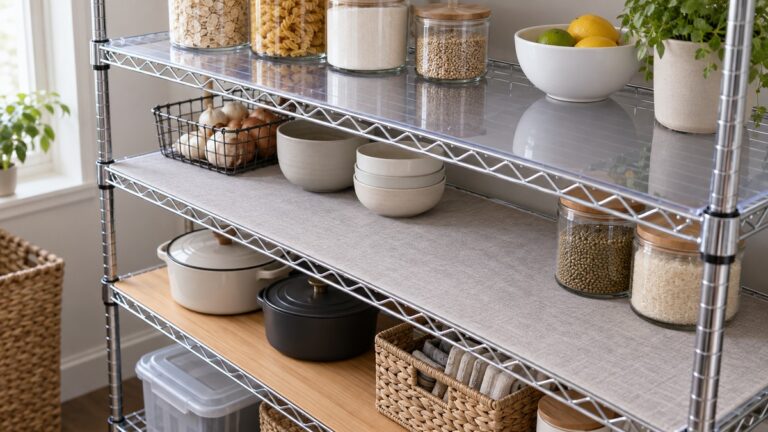
Take everything off, and sort it as you go. Put back only what belongs there. The same Arkansas page suggests thinking about things that can cover shelves to keep messes quickly fixable, which you can use when you reload. For one option that suits this, see our guide to wire shelf covers.
Wipe the items you are putting back. The Hunker article on sticky ClosetMaid shelving recommends wiping down the items with a mild product, because they may have buildup from sitting on a dirty shelf.
Step 2: Do the dry pass first
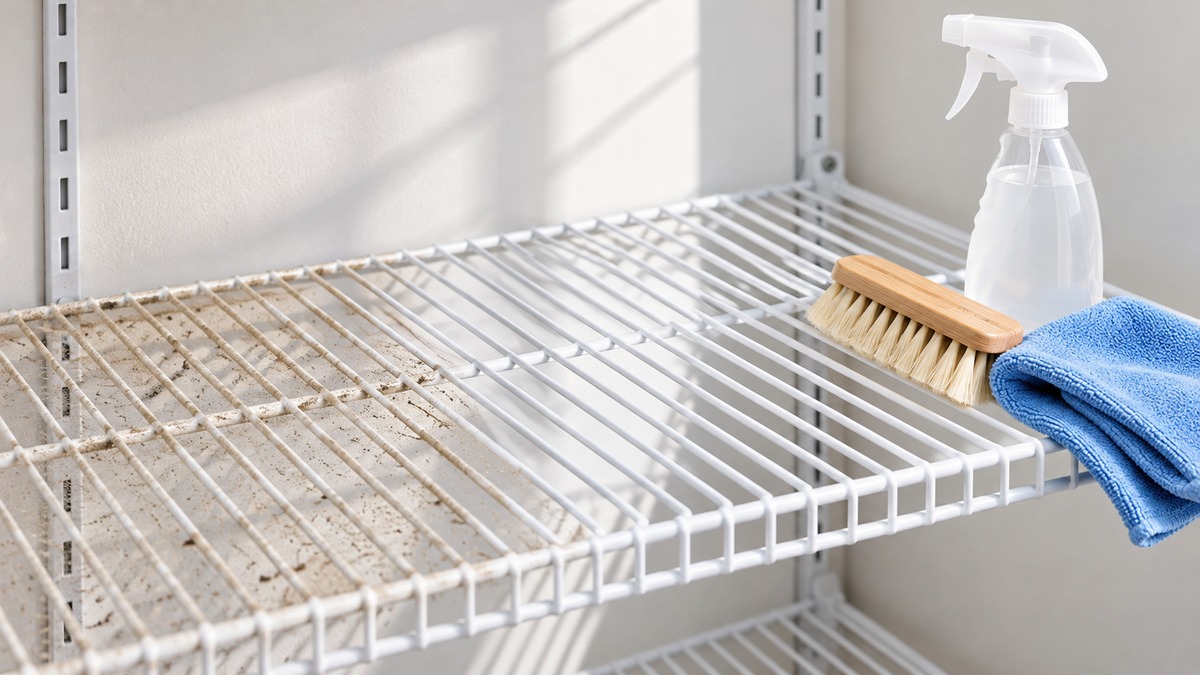
Dry dust should come off before any water touches the shelf. The Arkansas page says to vacuum highly dusty areas first, while they are dry, because that avoids spreading dirt when you clean with wet rags or sponges. The Hunker article gives the same order for wire shelving: brush the shelving with the hose attachment of a vacuum cleaner to pick up dry spills and dust, and use a handheld broom if the debris is not deep.
Work from the top shelf down. The Arkansas page says to start at the top of a room and work toward the floor, and that logic carries over to a tall unit, since dust and crumbs fall to the shelf below. A top-to-bottom order means you never clean a lower shelf twice.
There is also a reason to remove dust that goes beyond appearance. The National Park Service Museum Handbook appendix on metal objects says dirt and dust may contain chemical compounds that react with metals or trap moisture close to the metal surface. That appendix is written for museum collections, so it is a close fit rather than an exact one, but it supports taking dust off steel.
Step 3: Wash with mild soap and water
The InterMetro FAQ answers the question in one line: “Wipe wire shelving with mild soap and water”. It adds that the shelves should then be dried thoroughly to prevent moisture buildup, and that spills should be handled quickly. The same FAQ says that avoiding harsh chemicals protects the coatings on the wire.
The US Environmental Protection Agency gives similar wording for hard surfaces that have been affected by mold. It says to scrub mold off hard surfaces with detergent and water, and to dry them completely. Taken together, the two pages give the simplest plan: soap or detergent, water, and a complete dry.
Wire has many small contact points. A cloth or sponge reaches the long wires, but the joints where the cross wires meet the side wires collect grime. The Hunker article suggests a toothbrush or cotton swab for hard-to-reach spots and a skinny wooden skewer for stubborn muck in tiny joints. None of the sources we opened says which tools are safe on a particular coating, so go lightly on a coated shelf.
Step 4: Handle sticky, greasy or labeled spots
Stickiness has two causes in the Hunker article. In the kitchen, the plastic coating on wire shelves attracts cooking oils from the air, and fine dust from dish cloths sticks to it. A tacky texture in a closet can also come from long exposure to high humidity. Knowing which cause you have tells you whether to deal with grease or with moisture.
This is where the sources disagree. The table sets them side by side.
| Option | Who mentions it | What the page says |
|---|---|---|
| Mild soap and water | InterMetro FAQ; EPA mold page | InterMetro: wipe with mild soap and water, then dry thoroughly. EPA: detergent and water on hard surfaces, then dry completely |
| Adhesive remover (Goo Gone) | ClosetMaid FAQ; Hunker article | ClosetMaid recommends it to clean wire shelves and remove label stickers; Hunker names it for stubborn greasy buildup |
| Household cleaners and wipes | Hunker article | Names Pine-Sol and Lysol wipes as working well |
| Rubbing alcohol mix | Hunker article | One part rubbing alcohol to two parts water, with a few drops of dish soap |
| Vinegar mix | Hunker article | A cup of white distilled vinegar with a cup of distilled water, half a juiced lemon and a few drops of essential oil |
| Avoid harsh chemicals | InterMetro FAQ | Harsh chemicals can damage protective coatings |
InterMetro writes about its own chrome, epoxy and stainless finishes, and it says harsh chemicals can damage protective coatings. The Hunker article says ClosetMaid shelving is built to handle the stronger cleaners it lists. ClosetMaid’s own FAQ only names Goo Gone for wire shelves, and for its laminate it says to avoid harsh chemical cleaners. Two manufacturers and one consumer article do not give one rule, so the cautious reading is the safer one: start with soap and water, and move to a stronger product only for a spot that soap does not clear.
The Hunker article suggests dabbing a cotton swab of cleaner on the shelf before dousing it. Do that on an underside or a back corner where a mark would not show. The pages we opened do not state a safe contact time for any of these products, so wipe the cleaner off and rinse rather than leaving it to sit.
Mixing the home recipes
Two of the recipes in the Hunker article are ratios, which are easy to scale. The table turns them into cup measures. These are our arithmetic from the article’s ratios, using the standard US cup of 8 fluid ounces, and the sizes are our assumption about what a household might make.
| Mix | Ratio in the article | Small batch | Larger batch |
|---|---|---|---|
| Rubbing alcohol and water | 1 part alcohol to 2 parts water | 1/2 cup alcohol + 1 cup water = 1 1/2 cups (12 fl oz) | 1 cup alcohol + 2 cups water = 3 cups (24 fl oz) |
| Vinegar and water | 1 cup vinegar to 1 cup distilled water, plus half a lemon | 1/2 cup vinegar + 1/2 cup water + 1/4 lemon = 1 cup of liquid before the lemon juice (8 fl oz) | 2 cups vinegar + 2 cups water + 1 lemon = 4 cups of liquid before the lemon juice (32 fl oz) |
For the alcohol mix, one third of the liquid is alcohol, so a 12-ounce batch holds 4 ounces of alcohol and 8 ounces of water. The article warns that the aroma of rubbing alcohol can be overwhelming in enclosed spaces. It says the vinegar mix keeps up to one week in a cool, dark place, so a small batch avoids waste. None of these recipes uses bleach. The EPA brief guide on mold says never to mix chlorine bleach solution with other cleaning solutions or detergents that contain ammonia, because toxic fumes could be produced.
Removing labels
New shelves often carry stickers. The ClosetMaid FAQ says its labels are designed to be removable without any cleaner, and that a product such as Goo Gone can be used if they do not peel off easily. Peel first, then use the product only on the residue, and wash the spot with soap and water afterward.
Step 5: Dry every wire before you reload
Drying is the step that protects the shelf. The InterMetro FAQ says to dry thoroughly to prevent moisture buildup. The Hunker article says to let the shelving dry for at least 15 minutes before putting anything back. A University of Illinois Physics Van answer on steel wool explains the chemistry in plain terms: rust forms when the iron in steel combines with oxygen from the air, and that happens a lot faster when water is present, so drying after use and storing in a dry place slows it down.
A Lehigh University corrosion page says the same thing from the other side. Rusting is a process in which iron combines with water and oxygen, and it can be prevented by excluding air and water from the surface. That is the case for towel-drying the wires and leaving the unit empty until the surface is dry to the touch, rather than relying on the open design alone.
Rust, flaking and coating damage
The sources describe prevention far better than repair. InterMetro says the best way to prevent rust is to choose a finish that matches the environment, and that chrome suits dry storage while epoxy-coated and stainless options resist corrosion in damp, humid or cold areas. It also says that controlling humidity and keeping wet items off the shelves will further protect wire shelving from rust.
The Lehigh page adds a reason not to ignore small spots. It says rust is brittle and flakes off the surface of the iron, which keeps exposing fresh metal. In other words, a rust spot does not seal itself. If you see a rust spot on a coated shelf, the pages we opened give no repair method, so the practical choices are to contact the maker of your shelves and to keep the area dry. We do not endorse a specific rust remover, and none of the pages we opened names one for coated wire.
If you see mold-like spots
Dark patches on closet shelves are worth reading carefully. The Kansas State University extension publication on mold describes growth that can often be seen as discoloration ranging from white to orange and green to brown and black. The EPA says that the key to mold control is moisture control, and that if the area is less than about 10 square feet, roughly a 3 foot by 3 foot patch, most people can handle the cleanup themselves.
For the cleanup itself, the EPA’s brief guide lists an N-95 respirator, gloves and goggles as protective gear, and the mold page says to scrub hard surfaces with detergent and water and dry them completely. Porous materials such as ceiling tiles and carpet may have to be thrown away if they become moldy. Wire is not porous, but any fabric liner, cardboard box or wooden item stored on the shelf can be. The EPA brief guide also says that if you clean up the mold but do not fix the water problem, the mold problem will most likely come back, so look for the moisture source.
Keep wire shelves clean longer
Several of the sources point to the same habits, and they cost little.
- Keep air moving. The University of Florida sheet notes that open shelving of plastic coated wire allows air circulation, and the Kansas State publication says closets should not be overfilled because that reduces air circulation. InterMetro says the open-wire design promotes airflow to help reduce dust and moisture buildup.
- Keep wet items off. InterMetro lists keeping wet items off the shelves as part of rust protection.
- Keep items off the floor. The Florida sheet says moisture can be trapped under items on the floor, and the National Park Service appendix advises against putting metal objects directly on the floor or close to exterior walls. A freestanding wire unit sits at floor level, so check its feet and the wall behind it.
- Use liners with care. InterMetro says very small or unstable items may need shelf liners or trays, and that wire offers less spill containment than solid shelving. The Lehigh page lists avoiding absorptive materials such as felt and fabrics in contact with metal as a corrosion-control step. Our reading is that a fabric liner that stays damp is a poorer choice than a smooth tray you can wipe, but the pages do not rank liners. For divider options, see our review of clip-on wire shelf dividers.
A cleaning plan with times
The only time figure in the sources is the 15-minute dry time from the Hunker article. The other minutes in this table are our own assumption for one five-shelf unit, so adjust them to your unit.
| Step | Task | Minutes | Basis |
|---|---|---|---|
| 1 | Empty the unit and sort items | 10 | Our assumption |
| 2 | Vacuum or brush, top shelf to bottom | 5 | Our assumption |
| 3 | Wash with soap and water, including joints | 15 | Our assumption |
| 4 | Treat sticky or labeled spots | 5 | Our assumption |
| 5 | Dry, then wait before reloading | 15 | Hunker: at least 15 minutes |
| 6 | Wipe items and reload | 10 | Our assumption |
| Total | 10 + 5 + 15 + 5 + 15 + 10 | 60 | Arithmetic |
The total is 60 minutes, and 15 of those are waiting time you can spend on the next task. If your unit is a closet shelf run, as in our guide to closet organizer ideas for wire shelving, clean one run at a time so the closet is not empty for long.
How we chose
This is a method guide, not a product list. We read thirteen pages on 2026-10-21: two InterMetro pages, one ClosetMaid FAQ, one Edsal MuscleRack support page, one consumer article, two EPA pages, three university extension documents, a Lehigh University page, a University of Illinois Q&A and the National Park Service metal-objects appendix. We kept a step only if at least one page states it plainly. Where pages disagree, as with cleaner strength, we show both and let the caution rule decide the order. We left out advice from pages that could not be opened. The minutes in the plan and the cup sizes in the mixing table are our own arithmetic or assumptions, and each one is labeled.
Mistakes to avoid
- Wetting the shelf before the dry pass. The Arkansas page says vacuuming dry dust first avoids spreading dirt when you use wet rags.
- Reaching for harsh chemicals first. InterMetro says harsh chemicals can damage protective coatings.
- Reloading a damp shelf. InterMetro and Hunker both put drying before reloading, and the Illinois answer says rust is much faster when water is present.
- Mixing cleaners. The EPA brief guide warns against mixing chlorine bleach with cleaners that contain ammonia.
- Cleaning mold without fixing the leak. The EPA says mold will most likely come back if the water problem is not fixed.
- Overfilling a closet run. The Kansas State publication says closets should not be overfilled because that reduces air circulation.
What we could not verify
The sources we opened do not give a cleaning interval, a safe contact time for any product, or a rust-removal method for coated wire. They do not say whether a given product is safe on a given coating, and the manufacturer pages disagree with the consumer article on cleaner strength. No page we opened covers dishwashers, pressure washers or steam for home wire shelves. The Hunker article is a consumer article from 2018 and not a manufacturer instruction. The University of Florida sheet is an archival copy written for Florida homes, and the National Park Service appendix is written for museum metal objects. The InterMetro and MuscleRack pages describe commercial lines, so their finishes may not match your shelf. If your shelves came with a care sheet, follow it over anything here.
Frequently asked questions
What is the safest way to clean wire shelves?
Start with mild soap and water, then dry thoroughly. That is the method the InterMetro FAQ gives, and the same FAQ says to avoid harsh chemicals that can damage protective coatings.
How do I clean sticky wire shelves?
Vacuum or brush off dry debris, then wash with soap and water. For stubborn greasy buildup, the Hunker article names an adhesive remover and a rubbing alcohol mix, and the ClosetMaid FAQ names an adhesive remover for wire shelves. Dab a small hidden spot first and rinse afterward.
Can I use vinegar on wire shelves?
The Hunker article gives a vinegar recipe and says ClosetMaid shelving can handle it. InterMetro does not mention vinegar and warns against harsh chemicals on coatings, and the pages we opened do not settle the question. Try it on a hidden spot and rinse well.
Do wire shelves rust?
Steel can rust when it meets water and oxygen, and the University of Illinois answer says water speeds this up. InterMetro says chrome suits dry storage and corrodes quickly in damp or cold places, so keep the shelves dry.
How long should wire shelves dry before I put things back?
The Hunker article says at least 15 minutes. InterMetro asks for a thorough dry without giving a time, so feel the wires for dampness before reloading.
What if I find mold on my wire shelves?
For a small patch, the EPA says most people can handle cleanup, using detergent and water on hard surfaces and a complete dry. It also says to fix the water problem or the mold will likely return.
Bottom line
Vacuum first, wash with mild soap and water, treat sticky spots one at a time, and do not reload until every wire is dry.
For the finish and capacity side of wire shelving, see free standing wire shelves for the kitchen and the ClosetMaid wire shelf weight limit guide.
Sources
- https://metro.com/faq/wire-shelving/ (opened 2026-10-21)
- https://metro.com/wire-shelving/ (opened 2026-10-21)
- https://www.homebyames.com/en-us/ho/ho-faqs.html (opened 2026-10-21)
- https://www.hunker.com/13420550/how-to-clean-sticky-closetmaid-wire-shelving/ (opened 2026-10-21)
- https://www.epa.gov/mold/mold-cleanup-your-home (opened 2026-10-21)
- https://www.epa.gov/mold/brief-guide-mold-moisture-and-your-home (opened 2026-10-21)
- https://journals.flvc.org/edis/article/download/108194/103485/149853 (opened 2026-10-21)
- https://www.shawnee.k-state.edu/homeandfamily/pdfs/Controling%20mold.pdf (opened 2026-10-21)
- https://www.lehigh.edu/~amb4/wbi/kwardlow/corrosion.htm (opened 2026-10-21)
- https://van.physics.illinois.edu/ask/listing/16962 (opened 2026-10-21)
- https://uaex.uada.edu/counties/carroll/torries-top-tips-blog/posts/deep_cleaning.aspx (opened 2026-10-21)
- https://www.nps.gov/subjects/museums/upload/MHI_AppO_MetalObjects.pdf (opened 2026-10-21)
- https://edsalmanufacturingcompany.freshdesk.com/support/solutions/articles/153000070249-musclerack-chrome-wire-shelving (opened 2026-10-21)
As an Amazon Associate we earn from qualifying purchases.