How to Store Holiday Decorations
As an Amazon Associate we earn from qualifying purchases.
How to store holiday decorations comes down to four choices: how each item is cleaned and wrapped, what it is packed in, where the bins sit, and what you check next season. The National Park Service leaflets, university extension pages and electrical safety pages we opened agree on three points: clean and dry items first, keep fabric away from attics and basements, and inspect light strings before you reuse them. They differ on wrapping paper and plastic, so this guide shows both sides.
Quick answer
- Clean and fully dry every item before it goes into a bin. The National Park Service says textiles relatively free of dust and food stains are less susceptible to microorganism growth.
- Wrap fabric items in acid-free tissue or washed muslin, not colored tissue, and keep them off bare wood and regular cardboard.
- Keep fabric decorations out of attics, basements and other spaces where temperature and humidity swing, as the University of Nebraska-Lincoln Extension advises for textiles.
- Inspect light strings for cracked sockets, frayed wires and loose connections when you pack them and again before you plug them in.
Sort by what each item is made of
Holiday boxes mix fabric, glass, plastic, wire and electrical parts. The sources treat each material differently, so sort before you pack. The table lists what the pages we opened say for each group and where they stop.
| Group | What the sources say | Where they stop |
|---|---|---|
| Fabric: stockings, tree skirts, table linens | Clean first; wrap in soft, unbuffered, neutral pH tissue (National Park Service) or acid-free tissue or washed unbleached muslin (Nebraska Extension); avoid direct contact with wood and regular cardboard; avoid colored tissue | Written for museum textiles and quilts, so a close fit and not an exact one |
| Delicate ornaments | Mississippi State Extension suggests wrapping them in used wrapping paper; the National Park Service says paper made from wood fibers contains lignin, which produces acid over time | No page tests wrapping paper or covers glass ornaments by name |
| Light strings and cords | Inspect for broken or cracked sockets, frayed or bare wires and loose connections; throw away damaged strands; use indoor lights indoors and outdoor lights outdoors | No page gives a way to coil or store them |
| Artificial trees | Mississippi State Extension says to unpack and store the tree carefully each year so it can be reused, and to order replacement parts if it is damaged | No page gives a box type or storage place for trees |
| Dried and natural pieces | Oklahoma State Extension says dried flowers, cornstalks and crepe paper can easily catch fire and should be kept away from heat sources during display | No page covers storing them |
The table shows a pattern. The fabric advice is the most detailed, because conservators and textile specialists have written it. The advice for glass, trees and natural pieces is thin, and we say so rather than fill the gap.
Clean and dry first
The National Park Service leaflet on mold and mildew on textiles says microorganisms often start growth on soil and on textile finishes such as starch and sizing, and that textiles relatively free of dust and food stains are less susceptible to becoming a host. A stocking with a cookie smear is exactly the kind of soil the leaflet means. Remove dust and food stains from fabric items in the way their care labels allow, and wipe hard items before packing.
Drying matters as much as cleaning. The EPA’s mold guide says the key to mold control is moisture control, and that items dried within 24 to 48 hours after a leak or spill usually do not grow mold. That figure is about water damage, not about holiday bins, but the principle carries over: do not seal a damp item into a closed bin. For a tree skirt or table runner that has been washed, let it dry fully, then wrap it.
Where to store: what the sources say about temperature and humidity
The sources give targets for different goals, so the numbers do not match. The table sets them side by side. The goals are in the first column because they explain the gaps.
| Source and goal | Temperature | Relative humidity |
|---|---|---|
| National Park Service, textile storage in collections | 64 to 68 F recommended, upper limit 75 F | Below 65 percent, 50 to 55 percent if possible |
| National Park Service, mold prevention in collections | Not stated in the passage we used | 45 to 55 percent, and always below 65 percent |
| Nebraska Extension, ideal storage to preserve a quilt indefinitely | 50 to 60 F | About 50 percent |
| EPA, indoor air in homes | Not stated | Below 60 percent if possible, ideally 30 to 50 percent |
The temperature figures do not overlap: the Park Service range starts at 64 F, and the Nebraska range ends at 60 F. The humidity figures overlap at one point. The Park Service range of 50 to 55 percent, the Nebraska figure of about 50 percent and the top of the EPA’s ideal range of 50 percent all include 50 percent. That overlap is our own reading, not a figure any one page gives. The Park Service leaflet also says the conditions should be maintained consistently, because fluctuations may allow dormant spores to begin growth.
It also reports that growth on textiles is noted when relative humidity is above 50 percent and spreads rapidly above 80 percent. A dehumidifier can pull moisture out of the air, according to the same leaflet, while desiccant bags must be monitored because they absorb moisture and lose effectiveness. It also suggests replacing stagnant air with gentle circulation.
Attic, basement, garage or closet
The Nebraska publication says to avoid storing textiles in attics, basements, kitchens and unheated areas because temperature and humidity vary too much there. The University of California Agriculture and Natural Resources blog adds that garages, basements, attics and other storage spaces can attract pests. A Utah State Extension garage guide, by contrast, says an attic or exposed ceiling joists can hold seasonal decorations and other items that are used once a year, and ClosetMaid’s planning guide says holiday decorations can go on higher, sturdy shelves.
These do not contradict each other if you read the scope. The Nebraska advice is for textiles, and the Utah State guide is about freeing garage floor space. Our reading is that fabric and keepsake items belong in a closet or other conditioned space, while hard, sturdy items tolerate more variation. None of the pages we opened tests how much variation an ornament or a plastic wreath tolerates, so that second half is a judgment and not a finding. For overhead options, see our guide to a ceiling storage unit and our guide to top shelf closet storage.
What to pack in: plastic, cardboard or fabric
Containers are where the sources disagree most. The table lists each option with what the sources say for and against.
| Container | What the sources say |
|---|---|
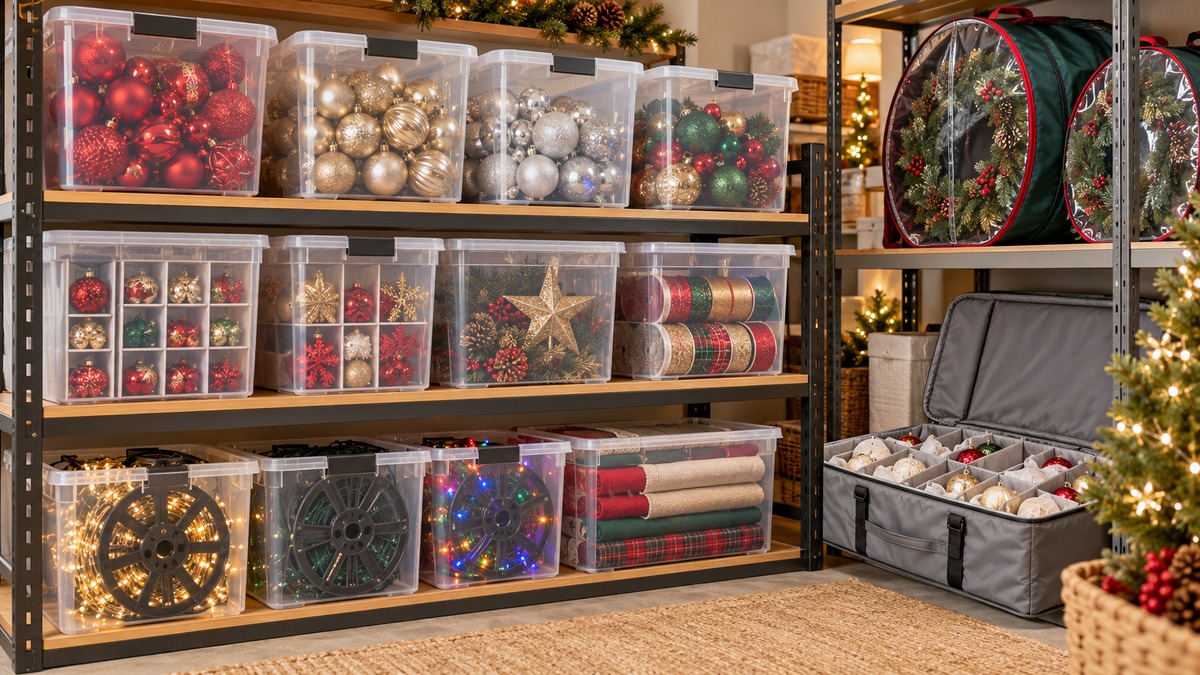
| Plastic bins with lids | UC ANR suggests airtight containers such as plastic bins to keep out pests; Utah State Extension calls lidded plastic containers stackable and says clear ones are especially helpful; the National Park Service lists polyethylene and polypropylene as safer plastics for storage |
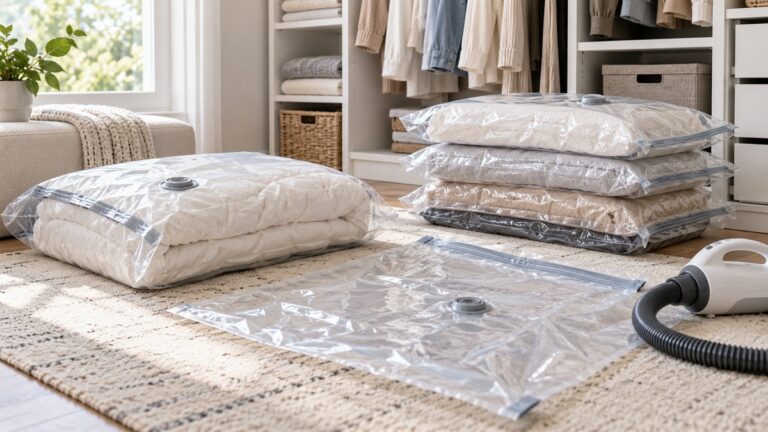
| Plastic bags | Nebraska Extension says quilts should not be stored in plastic bags because they limit air circulation and trapped moisture can result in mildew; Kansas State suggests vacuum-sealed bags to reduce bulk |
| Plastics to avoid | The National Park Service says not to use PVC, PVDC, PVA, acidic polyesters, polyurethane foams, chloroprene or urea formaldehyde panels for long-term storage |
| Cardboard and paper | Nebraska Extension says regular cardboard and paper give off acid byproducts as they age, so line boxes with acid-free tissue or washed muslin |
| Breathable fabric | The National Park Service asks whether a breathable textile would be better than plastic if humidity is high or fluctuates |
Putting this together, a lidded polyethylene or polypropylene bin guards against pests, and the same seal can trap moisture if the contents or the room are damp. That is why the drying step comes first, and why fabric keepsakes may be better in a breathable wrap inside a bin than loose in plastic. The pages do not say which plastic your bin is made of, so look for a resin code or the maker’s description before you rely on the Park Service list.
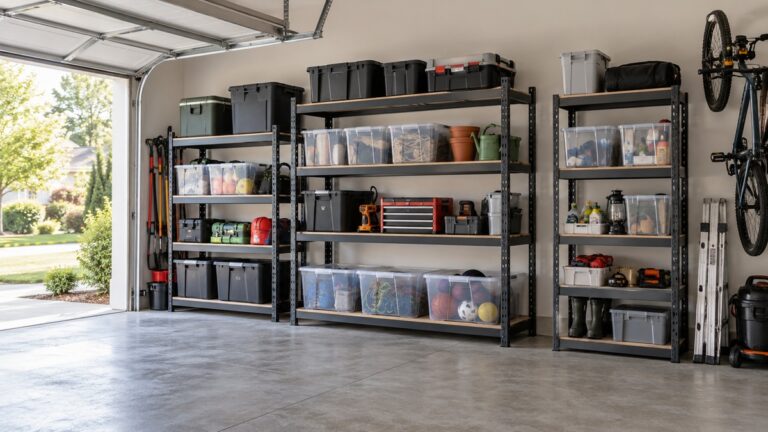
Kansas State adds a labeling rule: label bins and totes with the person’s name and note if the contents are seasonal. UC ANR says to store bins off the floor and away from walls. For shelf options that suit stacked totes, see our guide to basement shelves for totes.
Fit the bins to the shelf: a worked table
Bins only help if they fit the shelf. The table uses outside dimensions that Sterilite lists on its tote pages and the two unit sizes that the MuscleRack boltless wire-deck page lists: 36 by 18 inches and 48 by 24 inches, width by depth. The unit size is the listed overall size, so the real shelf deck may be a little smaller, and the counts are upper limits. We turn each tote to whichever direction fits more, and we count only whole totes.
| Tote (outside L × W × H, inches) | On a 36 × 18 shelf | On a 48 × 24 shelf | Height of two stacked |
|---|---|---|---|
| 12 gal latch: 19.5 × 15.375 × 13.875 | 1 (19.5 wide, 15.375 deep) | 3 (turned, 15.375 wide, 19.5 deep) | 2 × 13.875 = 27.75 |
| 18 gal: 23.5 × 18.375 × 16.125 | 0 (18.375 deep is more than 18) | 2 (turned, 18.375 wide, 23.5 deep) | 2 × 16.125 = 32.25 |
| 27 gal: 28.5 × 19.625 × 15.5 | 0 | 1 (28.5 wide, 19.625 deep) | 2 × 15.5 = 31 |
| 38 gal: 37.5 × 21.625 × 15.875 | 0 | 1 (37.5 wide, 21.625 deep) | 2 × 15.875 = 31.75 |
Three results stand out. An 18-inch-deep shelf holds none of the three larger totes, because every one is deeper than 18 inches in its shorter direction. On a 48 × 24 shelf, a 27-gallon tote plus a turned 12-gallon latch tote use 28.5 + 15.375 = 43.875 inches of the 48-inch width. And two stacked 18-gallon totes stand 32.25 inches tall, which tells you how much clear height one stack needs. The sources we opened give no weight for a packed holiday bin, so the table says nothing about load.
Where on the shelf: heavy low, light high
The height rules come from ergonomics and shelving safety sheets. The University of Oregon shelving sheet says to store heavier and frequently used items in the knee to shoulder range, to put lighter items overhead, and never to climb on shelves or reach overhead. The University of British Columbia lifting guide says the strongest lifting zone is between mid-thigh and waist height, and that only lighter items belong above the shoulder and below the knee. ClosetMaid says holiday decorations can go on higher, sturdy shelves.
Reading them together, the safe place for a heavy bin is the middle band, and the top shelf suits only a light one. That reading is ours. Sort the bins by weight when you pack, and mark the weight on the label so the person who lifts it next year knows. The University of Oregon sheet also says not to overload shelves or let items hang over the edge.
Check lights and cords before and after
Light strings need their own step because of the electrical risk. The Electrical Safety Foundation International sheet says to inspect electrical decorations for damage before use, and that cracked or damaged sockets, loose or bare wires and loose connections may cause a serious shock or start a fire. Oklahoma State Extension gives the same checklist, says damaged strands should be thrown away, and adds that extension cords should be checked to make sure they work properly. It also says to look for a mark from a recognized testing lab such as UL and to use indoor lights indoors and outdoor lights outdoors.
The practical sequence is to inspect when you take lights down, discard what is damaged, and inspect again when you take them out next year. The pages we opened do not say how to coil or wrap light strings, so choose a method that does not pinch or kink the wire. The ESFI sheet lists cords being pinched or forced into small spaces as a hazard in use, which suggests the same care in storage, but that is our inference.
A pack-away routine
- Sort. Utah State Extension’s order is sort, purge, assign a place and containerize last. Let go of what you no longer use before you buy bins.
- Clean. Remove dust and food stains from fabric, because the Park Service leaflet links them to microorganism growth.
- Dry. Let every washed or wiped item dry before wrapping.
- Wrap. Use acid-free tissue or washed muslin for fabric and keepsakes, and avoid colored tissue.
- Inspect. Discard damaged light strings and cords.
- Pack by category. Keep the fabric, the lights and the ornaments in separate bins.
- Label. Write the contents, whether they are seasonal, and the weight on the bin.
- Place. Heavy bins in the middle band, light bins higher, all off the floor.
The order is a synthesis of the sources, and the sources do not give a time for any step.
How we chose
This is a method guide, not a product list. We read twenty-one pages on 2026-10-21: four National Park Service Conserve O Gram leaflets, one University of Nebraska-Lincoln Extension publication, six other extension or university pages, two ergonomics and shelving safety documents, one ClosetMaid planning guide, one EPA guide, one electrical safety sheet, and manufacturer pages for four totes and one shelving unit. The tote and shelf pages supply dimensions only. We kept a step only if at least one page states it plainly, and where pages disagree we show both sides. The shelf-fit table is our own arithmetic.
Mistakes to avoid
- Packing fabric dirty or damp. The Park Service says dust and food stains make textiles easier for microorganisms to colonize, and moisture control is the key to mold control.
- Storing fabric in an attic or basement. Nebraska Extension says temperature and humidity vary too much in those areas.
- Using colored tissue. Nebraska Extension says most colored tissue is not colorfast and can stain textiles if moistened.
- Sealing keepsakes in plastic bags. The same publication advises against it for quilts, citing limited air circulation and mildew from trapped moisture.
- Reusing damaged lights. ESFI and Oklahoma State Extension both say to inspect lights, and Oklahoma State says to throw away damaged strands.
- Putting a heavy bin on a high shelf. The Oregon and British Columbia documents place heavy items in the middle band.
What we could not verify
The sources we opened do not cover glass ornaments, candles, natural greenery, inflatables or battery-operated decorations by name, and they do not say how to coil light strings. They give no weight for a packed holiday bin, no safe temperature range for plastic or glass decorations, and no way to tell which plastic a given bin is made of. The National Park Service leaflets are written for museum collections and the Nebraska publication for quilts, so their targets are a close fit for fabric decorations and not an exact one. The Rubbermaid bin pages returned an access error, so the bin dimensions come from Sterilite pages. If a decoration came with a care label or a maker’s storage note, follow it over anything here.
Frequently asked questions
What is the best way to store holiday decorations?
Clean and dry them, wrap fabric and keepsakes in acid-free tissue or washed muslin, pack by category in labeled bins, and store the bins off the floor in a space without big temperature swings.
Is it OK to store holiday decorations in the attic or garage?
Not for fabric. Nebraska Extension says to avoid attics, basements and unheated areas for textiles, while Utah State Extension notes an attic can hold seasonal decorations in general. Sturdy hard items are a judgment call, since no page tests them.
Should I use plastic bins or cardboard boxes?
Lidded plastic bins help against pests, according to UC ANR, but the National Park Service asks whether breathable fabric would be better when humidity is high. Nebraska Extension says regular cardboard gives off acid byproducts, so line any box with acid-free tissue.
How do I store Christmas lights?
Inspect them for cracked sockets, frayed wires and loose connections, throw away damaged strands, and inspect again next season. The pages we opened do not describe a coiling method.
How do I store an artificial tree?
Mississippi State Extension says to unpack and store it carefully each year so it can be reused. The pages we opened do not name a box type or storage location.
How do I wrap fragile ornaments?
Mississippi State Extension suggests used wrapping paper. The National Park Service says wood-fiber paper contains lignin that produces acid, so acid-free tissue is the cautious choice for keepsakes.
Bottom line
Clean and dry first, wrap fabric in acid-free tissue, keep it out of attics and basements, and inspect every light string before it goes back on the tree.
Sources
- https://www.nps.gov/subjects/museums/upload/16-01_508.pdf (opened 2026-10-21)
- https://www.nps.gov/subjects/museums/upload/03-04_508.pdf (opened 2026-10-21)
- https://www.nps.gov/subjects/museums/upload/04-09_508.pdf (opened 2026-10-21)
- https://www.nps.gov/subjects/museums/upload/18-02_508.pdf (opened 2026-10-21)
- https://extensionpubs.unl.edu/publication/g1820/2007/pdf/view/g1820-2007.pdf (opened 2026-10-21)
- https://extension.okstate.edu/programs/holidays-and-special-occasions/holiday-decoration-safety/avoiding-fall-winter-and-holiday-decorating-hazards (opened 2026-10-21)
- https://www.esfi.org/wp-content/uploads/2021/08/Top-10-Holiday-Safety-Tips.pdf (opened 2026-10-21)
- https://extension.msstate.edu/blogs/extension-for-real-life/6-holiday-recycling-tips (opened 2026-10-21)
- https://extension.msstate.edu/sites/default/files/publications/P4085_web.pdf (opened 2026-10-21)
- https://ucanr.edu/blog/pests-urban-landscape/article/unwanted-indoor-critters-theres-pest-notes (opened 2026-10-21)
- https://bookstore.ksre.k-state.edu/pubs/cut-the-clutter-and-get-organized-fact-sheet_MF2879.pdf (opened 2026-10-21)
- https://extension.usu.edu/archive/got-room-for-the-car-in-your-garage (opened 2026-10-21)
- https://www.homebyames.com/en-us/b2c_hba_simple_storageguide.html (opened 2026-10-21)
- https://safety.uoregon.edu/sites/default/files/safety_sheet_-_shelving_safety_final.pdf (opened 2026-10-21)
- https://hr.ubc.ca/sites/default/files/2020-09/Lifting%20Guidelines.pdf (opened 2026-10-21)
- https://www.epa.gov/mold/brief-guide-mold-moisture-and-your-home (opened 2026-10-21)
- https://www.sterilite.com/product/18-gal-tote-3/ (opened 2026-10-21)
- https://www.sterilite.com/product/27-gal-industrial-tote-2/ (opened 2026-10-21)
- https://www.sterilite.com/product/38-gal-industrial-tote-2/ (opened 2026-10-21)
- https://www.sterilite.com/product/12-gal-latch-tote/ (opened 2026-10-21)
- https://edsalmanufacturingcompany.freshdesk.com/support/solutions/articles/153000072255-musclerack-heavy-duty-steel-boltless-shelving-with-wire-decking (opened 2026-10-21)
As an Amazon Associate we earn from qualifying purchases.