How to Maximize Shelf Space
As an Amazon Associate we earn from qualifying purchases.
How to maximize shelf space starts with deciding what deserves a shelf, not with buying bins. The extension pages we opened put the order as reduce, sort, assign a place, and containerize last. After that, space comes from three levers: how many shelves you fit, how well each gap matches what sits in it, and which items go in the easiest reach band. This guide turns a planning formula from the NKBA into a way to count what each change adds, and it marks what the sources do not say.
Quick answer
- Reduce and sort first. Utah State Extension says containerizing comes last, and Oklahoma State Extension says to buy organizers after you declutter.
- Count your space the NKBA way: shelf width times the number of shelves times depth in feet. Every shelf you add to a bay adds the bay’s width times its depth in feet.
- Match each gap to what it holds. Adjustable shelves move in fixed steps, and the step size decides how much headroom goes unused.
- Keep daily items in the middle reach band, put heavy items low in that band, and do not overload any shelf.
Step 1: Reduce and sort before you touch a shelf
Every extension source we opened starts with fewer things, not more containers. Utah State Extension’s guide to reduced clutter gives a four-part order: sort by grouping similar items, purge what you can live without, assign a place that is logical, accessible and safe, and containerize. It says the art of containerizing is to do it last, not first. Oklahoma State University Extension makes the same point from the buying side: purchase organization items after you have decluttered, because that helps you avoid the wrong size bin, tote or basket.
Mississippi State University Extension recommends starting with a small area so you are not overwhelmed, sorting into four piles (keep, sell, donate, throw away), and finding a specific location for everything you keep. It also says to group similar items together so they are easy to find later. Penn State Extension gives a similar scale: pick one closet or one drawer, finish it, then move on. A Kansas State fact sheet uses a box approach with Keep, Store, Give Away or Sell, and Throw Away boxes, and suggests creating centers for work such as cleaning, cooking or hobbies.
A Utah State garage guide states the rule most plainly: the first step is to reduce the number of items stored. Its second step is to relocate items to other storage areas, and its third is to take items off the floor, storing them against the walls or hanging them from the ceiling. Those steps were written for a garage, but the order holds for any shelf: fewer items first, then better placement. An older North Carolina extension manual adds a related rule for bedrooms: use all available storage spaces before building any new ones.
Step 2: Count the shelf space you actually have
You cannot maximize what you have not measured. The National Kitchen & Bath Association’s Kitchen Planning Guidelines give a counting method for storage. Their Guideline 27 says shelf and drawer frontage is found by multiplying the cabinet width in inches by the number of shelves or drawers and by the cabinet depth in feet, with a fraction of a foot allowed. The guideline is written for kitchens, but the formula works as a way to compare any shelving plan.
The table applies it to one bay that is 30 inches wide. The bay width and the depths are our example values, and the arithmetic follows the NKBA formula.
| Shelves in the bay | 12 inch depth (1 ft) | 18 inch depth (1.5 ft) |
|---|---|---|
| 2 | 30 × 2 × 1 = 60 | 30 × 2 × 1.5 = 90 |
| 3 | 30 × 3 × 1 = 90 | 30 × 3 × 1.5 = 135 |
| 4 | 30 × 4 × 1 = 120 | 30 × 4 × 1.5 = 180 |
Two readings follow from the table. Adding one shelf to a 12 inch deep bay adds 30 inches of frontage, the width of the bay. Going from 12 to 18 inches of depth on three shelves adds 45 inches of frontage, but the extra depth is also the part that is hardest to reach, and the sources we opened do not say how deep is too deep.
The NKBA also gives totals for scale. A small kitchen, under 150 square feet, is given 1,400 inches of shelf and drawer frontage in total, split as 300 for wall cabinets, 520 for base cabinets, 360 for drawers, 180 for the pantry and 40 for miscellaneous. Those five numbers add to 1,400. The guidelines count storage above 84 inches in the miscellaneous category, which caps how much of that high space can count toward the total. By that scale, one added shelf in a 30 inch bay is 30 of 1,400 inches, or about 2.1 percent. That comparison is our own arithmetic, and it shows how small a single shelf is beside a whole kitchen. The same guideline notes that storage and organizing items can enhance the functional capacity of the storage, and that they should be chosen to meet user needs.
Step 3: Match each gap to what it holds
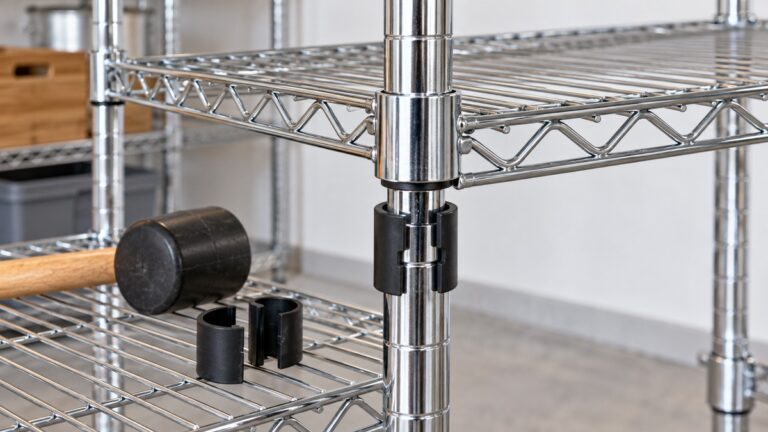
On a shelf unit with adjustable shelves, unused headroom is the largest source of wasted space, and the shelf step size decides how much. The InterMetro FAQ says its shelves reposition in 1 inch increments along numbered posts. The MuscleRack boltless wire-deck page says its shelves adjust in 1-1/2 inch increments. Both pages are manufacturer pages, and we use only the step sizes from them.
The rule behind the next table is simple. A gap can only sit at a multiple of the step, so a container needs the gap rounded up to the next step. The difference between that gap and the container height is unused headroom on every level. The unit height of 72 inches is our example, taken from the 72 inch height listed for MuscleRack models. The container heights are our assumptions, and the table ignores shelf thickness and the room your hand needs above a container, because the pages we opened give no figure for either.
| Container height (inches) | Step (inches) | Gap needed (inches) | Unused headroom per level (inches) | Levels in 72 inches | Unused inches in the whole unit |
|---|---|---|---|---|---|
| 6.25 | 1 | 7 | 0.75 | 72 ÷ 7 = 10.3, so 10 | 72 − (10 × 6.25) = 9.5 |
| 6.25 | 1.5 | 7.5 | 1.25 | 72 ÷ 7.5 = 9.6, so 9 | 72 − (9 × 6.25) = 15.75 |
| 8.5 | 1 | 9 | 0.5 | 72 ÷ 9 = 8 | 72 − (8 × 8.5) = 4 |
| 8.5 | 1.5 | 9 | 0.5 | 72 ÷ 9 = 8 | 72 − (8 × 8.5) = 4 |
| 10.75 | 1 | 11 | 0.25 | 72 ÷ 11 = 6.5, so 6 | 72 − (6 × 10.75) = 7.5 |
| 10.75 | 1.5 | 12 | 1.25 | 72 ÷ 12 = 6 | 72 − (6 × 10.75) = 7.5 |
The table shows three things. With the 6.25 inch container, the finer step fits one more level, and the unit holds 10 levels instead of 9. With the 8.5 inch container, both steps land on the same 9 inch gap, so the step size made no difference. With the 10.75 inch container, the coarse step wastes more headroom per level, but the whole unit still holds six levels either way. The practical lesson is to measure the container, round up to the step, and check the level count before you buy more of a container size.
That lesson also explains why the ClosetMaid storage planning guide suggests adjustable shelves when you need to fit large appliances such as a blender and a standing mixer in a pantry. A fixed shelf sets a gap that you cannot change later, and an adjustable one lets the gap follow the item.
Step 4: Put the right things in the reach band
Maximizing space does not mean using every inch equally. A shelf you cannot reach safely is not usable storage. The sources agree on a middle band, though they word it differently.
| Source | What it says about height |
|---|---|
| NKBA Kitchen Planning Guidelines | Plan storage of frequently used items 15 to 48 inches above the floor |
| University of Oregon shelving sheet | Install shelving so common items can be reached between average waist and shoulder height; store heavier and frequently used items in the knee to shoulder range; put lighter items overhead and seldom-used items on low shelves |
| University of British Columbia lifting guide | The strongest lifting zone is between mid-thigh and waist height; store only lighter items above shoulder level and below knee level |
| ClosetMaid storage planning guide | Keep regularly used pantry items easy to reach, store heavy and bulky items a little lower, and put rarely used items and holiday decorations on higher, sturdy shelves |
The sources do not match exactly. Oregon puts seldom-used items on low shelves, while ClosetMaid puts rarely used items on higher, sturdy shelves, and UBC puts only lighter items both above the shoulder and below the knee. A cautious reading is that the middle band belongs to daily items, the lower part of that band takes the heavy ones, and anything rare goes at the top or bottom only if it is light or if the shelf is sturdy.
The NKBA band is 48 minus 15, or 33 inches tall. The next table counts how many levels of the gaps from Step 3 fit in that band. The gap values come from the table above, and the count is our arithmetic.
| Gap (inches) | Levels in the 33 inch band | Band left over (inches) |
|---|---|---|
| 7 | 33 ÷ 7 = 4.7, so 4 | 33 − 28 = 5 |
| 9 | 33 ÷ 9 = 3.7, so 3 | 33 − 27 = 6 |
| 11 | 33 ÷ 11 = 3 | 33 − 33 = 0 |
| 12 | 33 ÷ 12 = 2.75, so 2 | 33 − 24 = 9 |
The 11 inch gap fills the band exactly, and the 12 inch gap loses a whole level. This is a quick test, not a rule from the NKBA. The band is written for kitchen storage, and the sources we opened do not give a band for other rooms.
The University of Oregon sheet also says never to climb on shelves or reach overhead, and to use a step stool or ladder. If the top of your unit can only be reached that way, treat it as long-term storage. For ideas on what to keep high, see our guide to top shelf closet storage.
Step 5: Use space you are not using
The Kansas State fact sheet asks a direct question: can you add shelves in unused areas that you may not have considered for storage? It names the area above a garage door or a closet door as a creative way to gain storage. The Utah State garage guide points to walls and ceilings, and says an attic or exposed ceiling joists can hold seasonal decorations and other items that are used once a year.
The older North Carolina manual suggests a step shelf to use the “waste space” on a closet shelf, and a shelf added below the standard rod and shelf, so the space above the floor is usable. That manual is a decades-old 4-H project guide, so treat the drawings as ideas and not as a standard. For small rooms, see our guide to closet organizing ideas for small spaces, and for tall storage that sits against a wall see bookcases for small spaces.
Hanging space has its own arithmetic
If you hang clothes, the rod is a shelf of its own. The Kansas State fact sheet says most clothing needs 2 to 3 inches of space for hanging, which allows air to move and prevents mold and mildew growth. ClosetMaid’s storage planning guide gives 48 inches as the maximum length of a hang rod in its systems. Dividing the rod length by the space per garment gives the range: 48 ÷ 3 is 16 garments, and 48 ÷ 2 is 24 garments. Packing more than that runs against the fact sheet, so cut back rather than squeeze.
Containers, bags and vertical folding
The Utah State garage guide says plastic containers with lids are possibly the most versatile accessories in modern storage systems, notes that they stack and come in many sizes, and says clear containers are especially helpful. Kansas State suggests vacuum-sealed storage bags to reduce bulk and increase storage capacity for items you store for later, and folding items to store them vertically in drawers so each item is visible when the drawer opens. The sources do not give a percentage of space saved by either method, so we do not either. For stacking bins on shelves, see our guide to basement shelves for totes and our guide to a storage shelf.
Step 6: Label, then keep it up
Kansas State says to label bins and totes with the owner’s name and whether the contents are seasonal. The Utah State garage guide says that once the space is organized, maintaining it should become a family affair, with rules such as promptly returning items that were taken out. Kansas State adds that new jobs take at least 2 to 4 weeks to become routine. None of the pages we opened gives a schedule for how often to re-sort a shelf, so pick a short, regular check and keep it.
How we chose
This is a method guide, not a product list. We read fourteen pages on 2026-10-21: the NKBA Kitchen Planning Guidelines, five university extension pages on clutter and organizing, one older state extension manual, two university safety and ergonomics documents, one Utah State garage guide, one ClosetMaid planning guide, two manufacturer pages for shelf adjustment steps, and one Kansas State publication on mold. We kept a step only if at least one page states it plainly, and we show where pages disagree on shelf height. The frontage table, the headroom table and the band table are our own arithmetic, and each input is named. Container heights and the 72 inch unit are labeled as our assumptions.
Mistakes to avoid
- Buying containers first. Oklahoma State Extension says to buy organizers after you have decluttered, to avoid the wrong size.
- Containerizing before sorting. Utah State Extension says to do it last, not first.
- Putting heavy items high. The University of Oregon sheet places heavier items in the knee to shoulder range, and UBC says to store only lighter items above the shoulder.
- Packing a shelf past what it can hold. The University of Oregon sheet says not to overload shelves or let items hang over the edge.
- Overfilling a closet. The Kansas State mold publication says closets should not be overfilled because that reduces air circulation.
- Counting unreachable shelves as usable. The University of Oregon sheet says never to climb on shelves or reach overhead.
What we could not verify
The sources we opened do not give a clearance to leave above a container on a shelf, a best shelf depth for a given item, or a share of each shelf to keep empty. They do not say how much space vacuum-sealed bags or clear containers save. The NKBA formula and band are written for kitchens, and the NC State manual is decades old. The InterMetro and MuscleRack pages describe their own adjustment steps and not every shelf. No page we opened covers wall-mounted racks, over-the-door organizers or shelf risers by name, so we do not rank them. If a shelving unit came with a load rating, follow it over anything in this guide.
Frequently asked questions
What is the first step to maximize shelf space?
Reduce what you store. Utah State Extension’s garage guide calls reducing the number of items the first step, and its desk guide puts containerizing last.
How do I count how much shelf space I have?
Use the NKBA method: width in inches times the number of shelves times depth in feet. It gives you a single number for comparing layouts, though it does not account for reach.
Do adjustable shelves save space?
They can, because the gap follows the item. InterMetro lists 1 inch steps and MuscleRack lists 1-1/2 inch steps, so a finer step can fit one more level, depending on the height of what you store.
Where should I put the things I use most?
In the middle band. The NKBA gives 15 to 48 inches above the floor for frequently used items, and the University of Oregon gives average waist to shoulder height.
Is it safe to fill a shelf to the edge?
The University of Oregon sheet says not to overload shelves and to make sure items are not hanging over the edge, and the Kansas State mold publication says closets should not be overfilled.
Do containers help or hurt?
Both. Clear stackable containers help, according to Utah State Extension, but Oklahoma State Extension warns that organizing containers can turn into more clutter if you buy them before you declutter.
Bottom line
Reduce first, count frontage with the NKBA formula, match each gap to what it holds, and keep daily items in the middle band.
Sources
- https://media.nkba.org/uploads/2022/05/Kitchen-Planning-Guidelines.pdf (opened 2026-10-21)
- https://extension.okstate.edu/announcements/pottawatomie-county/how-much-is-clutter-costing-you (opened 2026-10-21)
- https://extension.usu.edu/archive/wheres-my-desk_a-guide-to-reduced-clutter (opened 2026-10-21)
- https://extension.msstate.edu/publications/ways-conquer-household-clutter (opened 2026-10-21)
- https://bookstore.ksre.k-state.edu/pubs/cut-the-clutter-and-get-organized-fact-sheet_MF2879.pdf (opened 2026-10-21)
- https://ocr.lib.ncsu.edu/ocr/ua/ua102_200-001-bx0004-004-005/ua102_200-001-bx0004-004-005.pdf (opened 2026-10-21)
- https://safety.uoregon.edu/sites/default/files/safety_sheet_-_shelving_safety_final.pdf (opened 2026-10-21)
- https://hr.ubc.ca/sites/default/files/2020-09/Lifting%20Guidelines.pdf (opened 2026-10-21)
- https://extension.usu.edu/archive/got-room-for-the-car-in-your-garage (opened 2026-10-21)
- https://www.homebyames.com/en-us/b2c_hba_simple_storageguide.html (opened 2026-10-21)
- https://metro.com/faq/wire-shelving/ (opened 2026-10-21)
- https://edsalmanufacturingcompany.freshdesk.com/support/solutions/articles/153000072255-musclerack-heavy-duty-steel-boltless-shelving-with-wire-decking (opened 2026-10-21)
- https://www.shawnee.k-state.edu/homeandfamily/pdfs/Controling%20mold.pdf (opened 2026-10-21)
- https://extension.psu.edu/decluttering-with-less-hassle (opened 2026-10-21)
As an Amazon Associate we earn from qualifying purchases.