Typical Bookshelf Spacing: Shelf Heights for Common Books
Affiliate disclosure: As an Amazon Associate we earn from qualifying purchases.
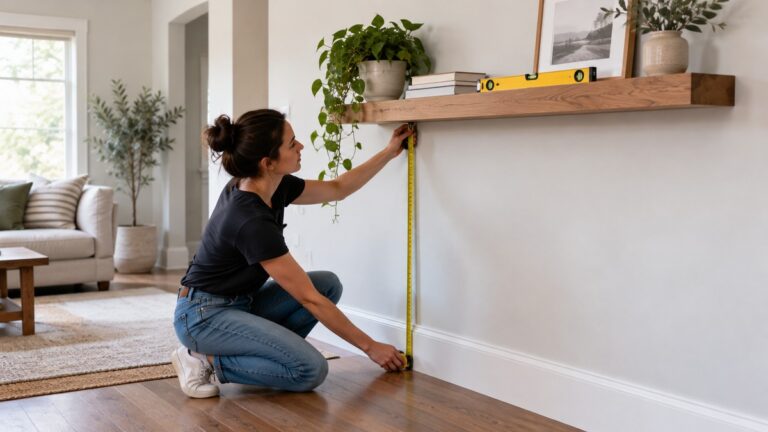
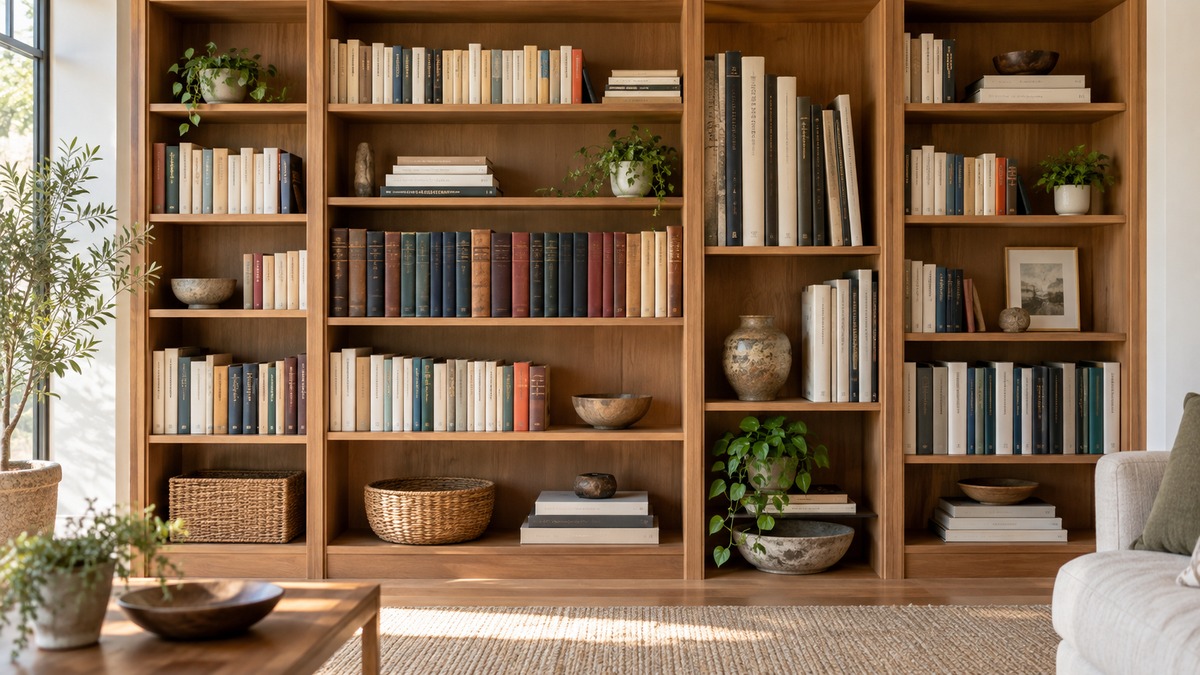
Typical bookshelf spacing for a home case is 8 to 12 inches between shelves in the woodworking guide we opened, but the tallest books set the minimum that works. That guide gives 7 to 15 inches as the general range, with 8 to 12 inches most common for bookshelves. A journal article on special collections gives a conventional 13.0-inch setting, with a 12.2-inch opening for books. This guide places those figures side by side, works the clearance for common book heights, and says where the figures do not apply.
Quick answer
- Woodbin’s guide gives 7 to 15 inches as the general range for shelf spacing, with 8 to 12 inches most common for bookshelves.
- In the RBM convention, spacing runs from the bottom of one shelf to the top of the next, so the shelf board takes part of it. The opening left for books is smaller than the spacing.
- A 13.0-inch spacing leaves a 12.2-inch opening, which clears books from 10.6 to 11.4 inches with 0.8 to 1.6 inches to spare.
- Use larger gaps near the bottom and smaller gaps near the top, as Woodbin advises, and put heavier items low.
What the sources give for spacing
Woodbin’s shelf guide states the range plainly: “Shelf spacing will generally range from 7 to 15 inches with 8 to 12 inches being common for bookshelves.” It also gives a layout rule: “To prevent the case from looking and being top-heavy, use a smaller shelf spacing near the top and a larger one near the bottom.” The guide is a woodworking reference, and the reason it gives is appearance and balance.
The RBM article gives a library convention instead. It describes a conventional setting of 33 cm (13.0 inches) from the bottom of one shelf to the top of the next, which leaves a 31 cm (12.2 inch) opening for the books. Those numbers come from special collections storage, not from home bookcases. They are useful for checking clearance, not for choosing a home style.
Work the opening for common book heights
The opening is the spacing minus the thickness of the shelf board. The RBM figures imply a board of 0.8 inch, because 13.0 minus 12.2 is 0.8. The article does not state a board thickness, so treat 0.8 inch as a working figure that the RBM numbers imply, not as a measured part. The same article gives the typical height of a regular or standard book as 27 to 29 cm, or 10.6 to 11.4 inches. The table subtracts those heights from three spacings, using the 0.8-inch figure.
| Spacing (bottom of one shelf to top of next) | Opening (spacing minus 0.8) | Clearance over an 11.4-inch book | Clearance over a 10.6-inch book |
|---|---|---|---|
| 13.0 inches | 12.2 inches | 0.8 inch | 1.6 inches |
| 12.0 inches | 11.2 inches | negative 0.2 inch, does not fit | 0.6 inch |
| 10.0 inches | 9.2 inches | negative 2.2 inches, does not fit | negative 1.4 inches, does not fit |
Read the table as arithmetic, not as advice for your case. At 12-inch spacing, the 0.8-inch board leaves an 11.2-inch opening. That clears a 10.6-inch book but not an 11.4-inch one. At 10-inch spacing, neither height fits. A Woodbin spacing of 8 to 12 inches therefore covers a wide range of outcomes, and the books you own decide which end of that range works.
Compare the three figures
The sources give three numbers that people often mix up. Two of them are spacing figures, and one is a height figure. Keep each one in its own setting before you apply it to a shelf.
| Source | Figure | Setting | Use it for |
|---|---|---|---|
| Woodbin shelf guide | 7 to 15 inches general range; 8 to 12 inches common | Woodworking reference for bookcases | A starting range for home spacing |
| RBM journal article | 13.0 inches from the bottom of one shelf to the top of the next, leaving a 12.2-inch opening | Special collections storage | Checking clearance for typical books |
| RBM journal article, citing NISO | Uprights of 84 or 90 inches | Single-tier steel bracket library shelving | A reference for overall height, not for spacing |
The first two rows are the spacing figures, and the third is only a height reference. If you are planning a six-shelf unit, the Nathan James Theo 6 shelf bookcase page is one product page to read alongside this plan.
Count the openings in a tall case
Woodbin says that bookcases are generally no higher than 84 inches. Dividing that height by a spacing gives a rough count of openings. The count is an estimate, because the shelf boards, the top and the bottom panels all take part of the height.
| Spacing (inches) | Calculation for an 84-inch case | Rough openings |
|---|---|---|
| 8 | 84 divided by 8 | 10.5 |
| 10 | 84 divided by 10 | 8.4 |
| 12 | 84 divided by 12 | 7.0 |
| 13 | 84 divided by 13 | 6.5 |
A 12-inch spacing gives about 7 openings in an 84-inch case before the panels are counted. The 13.0-inch RBM convention gives about 6 openings on the same height. If your room needs a smaller footprint, the bookcase ideas for small rooms page lists the next set of options to compare.
Check the books before the spacing
Measure the tallest books you plan to keep on the shelf, then choose spacing that clears them. Woodbin’s guide also ties depth to what the shelf holds: “Shelf depth is determined by the size of the items to be stored, generally within the range of 6 to 24 inches.” Height and depth are set by the same books, so check both before you buy a unit. For a shelf that will hold oversize volumes, the RBM article places oversize books above 29 cm, which is 11.4 inches, so plan a larger opening for them.
If you are comparing bookcases with fixed shelves, the VASAGLE vs Sweetcrispy bookcases compared page is one comparison to read, and the Sweetcrispy vs IRONCK bookcases compared page is another. Each one is a side-by-side look at two products, so use it to compare what each listing states about its own shelves.
Set the gaps for the weight on each shelf
Spacing and loading meet at the bottom of the case. Woodbin’s advice to use larger gaps near the bottom points the same way as the Consumer Product Safety Commission’s 2022 guidance, which says to “Store heavier items on lower shelves, or in lower drawers.” The commission’s text is about placing heavy items, not about spacing, so it does not give a gap figure. It does point the same way, which is useful when you choose where the wide openings go.
WebJunction’s library planning guide adds a planning habit. Its design figure leaves “approximately 25 -30% of the shelf left empty for collection management, shelving, and introduction of multiple volume sets.” A home shelf does not need that exact allowance, but the idea of leaving room to add books is the same. Leave an opening you can use, not only the minimum that fits today.
For a wall-mounted or open shelf, the floating shelves that can hold weight page covers the weight question readers ask next, and the wire shelf weight limit page covers wire shelving. The 5-shelf metal storage rack and the 5-tier metal shelving pages are two metal options to compare against your spacing plan.
Measure the books, then set the gaps
- Measure the tallest book on each shelf, in inches, from the top of the book to the shelf it stands on.
- Add the shelf board thickness to that height, using 0.8 inch only as the working figure implied by the RBM numbers.
- Choose a spacing that leaves a positive clearance for each shelf you plan to fill.
- Make the bottom gaps larger than the top gaps, as Woodbin advises, when the case is tall.
- Check the depth too, since Woodbin ties shelf depth to the size of the items to be stored.
Plan the lowest shelf
Woodbin’s guide places the lowest shelf close to the floor: “The lowest shelf should be 3 to 4 inches from the floor level.” That position sets the first opening in the case, so measure it with the same clearance sum as the openings above it. Use the books you plan to keep on that shelf, not the books you hope to add later.
A wall-mounted shelf follows the same spacing logic, but its support changes the answer. If you are comparing wall shelves in a living room, the small wall shelves for a living room page is one place to start, and the decorative floating wall shelves page covers another style.
How we chose
We chose the sources because each states a spacing, opening or height figure in a form a reader can check. The woodworking guide gives the common range. The journal article gives a library convention and a typical book height. WebJunction gives a planning habit for leaving room, and the Consumer Product Safety Commission gives the placement rule for heavy items. Every figure in this guide was matched against the fetched text of its page on 2026-10-21. The arithmetic uses the stated figures and names the one assumption it adds.
Mistakes to avoid
- Using the spacing as the opening. The shelf board takes part of the spacing, so the opening is smaller.
- Spacing the shelves for the average book. The RBM figures give a typical range, and an unusually tall book needs its own clearance.
- Putting the heaviest items on the top shelf. The commission’s guidance says to store heavier items on lower shelves.
- Leaving a bottom gap that is smaller than the top gap. Woodbin advises the opposite for a tall case.
- Choosing spacing before measuring the books. The books decide the minimum, not the catalog.
What we could not verify
- No source gives a shelf board thickness. The 0.8-inch figure is the difference between two RBM numbers, not a measured part.
- The RBM figures come from special collections. No source here shows a home bookcase with a 13.0-inch spacing.
- Woodbin’s 7 to 15 inch range is a woodworking reference. It does not state how it was derived.
- No source gives a spacing figure for a particular bookcase listing. Read the shelf spacing from the product page for the unit you want.
- The sources do not state a weight figure for any shelf, so this guide gives none.
- No source states how many openings a typical bookcase has. The counts in the table are estimates from the height and the spacing.
FAQ
What is typical bookshelf spacing for a home case?
Woodbin gives 7 to 15 inches as the general range, with 8 to 12 inches most common for bookshelves. The right spacing depends on the tallest books you plan to store.
How tall is a standard book?
The RBM article gives the typical height of a regular or standard book as 27 to 29 cm, or 10.6 to 11.4 inches. Measure your own books, because the article covers special collections.
Why is the opening smaller than the spacing?
In the RBM convention, spacing is measured from the bottom of one shelf to the top of the next, so the shelf board is part of it. The RBM figures of 13.0 inches and 12.2 inches differ by 0.8 inch, which the article does not label as board thickness.
Should the bottom shelves have larger gaps?
Woodbin advises a smaller spacing near the top and a larger one near the bottom, to keep a tall case from looking top-heavy. Pair that with the commission’s advice to store heavier items on lower shelves.
Does depth change the spacing?
Depth is set by the size of the items, according to Woodbin, so the depth and the spacing should be planned together. A deeper case does not change the height clearance by itself.
Can I use the RBM numbers for my own bookcase?
Use them as a check. The article describes special collections storage, so measure the books you own and compare the result with the 12.2-inch opening.
Bottom line
Space each shelf so the opening, after the board, is taller than the tallest book it will hold, and give the lower shelves the larger gaps.
Sources
- Woodbin, shelf design guidelines: https://woodbin.com/?p=1129 (opened 2026-10-21)
- Adams, “Shelving Special Collections Materials by Size,” RBM: A Journal of Rare Books, Manuscripts, and Cultural Heritage: https://rbm.acrl.org/index.php/rbm/article/download/25940/33866 (opened 2026-10-21)
- WebJunction, Space Planning Simplified (PDF): https://www.webjunction.org/content/dam/WebJunction/Documents/webJunction/Space-Planning-Simplified.pdf (opened 2026-10-21)
- U.S. Consumer Product Safety Commission, 2022 news release on anchoring TVs and furniture: https://cpsc.gov/Newsroom/News-Releases/2022/CPSC-Injury-and-Fatality-Report-Shows-Despite-Some-Progress-Need-for-TV-and-Furniture-Tip-Over-Prevention-Remains-Strong (opened 2026-10-21)
As an Amazon Associate we earn from qualifying purchases.