How to Clean a Bookshelf
As an Amazon Associate we earn from qualifying purchases.
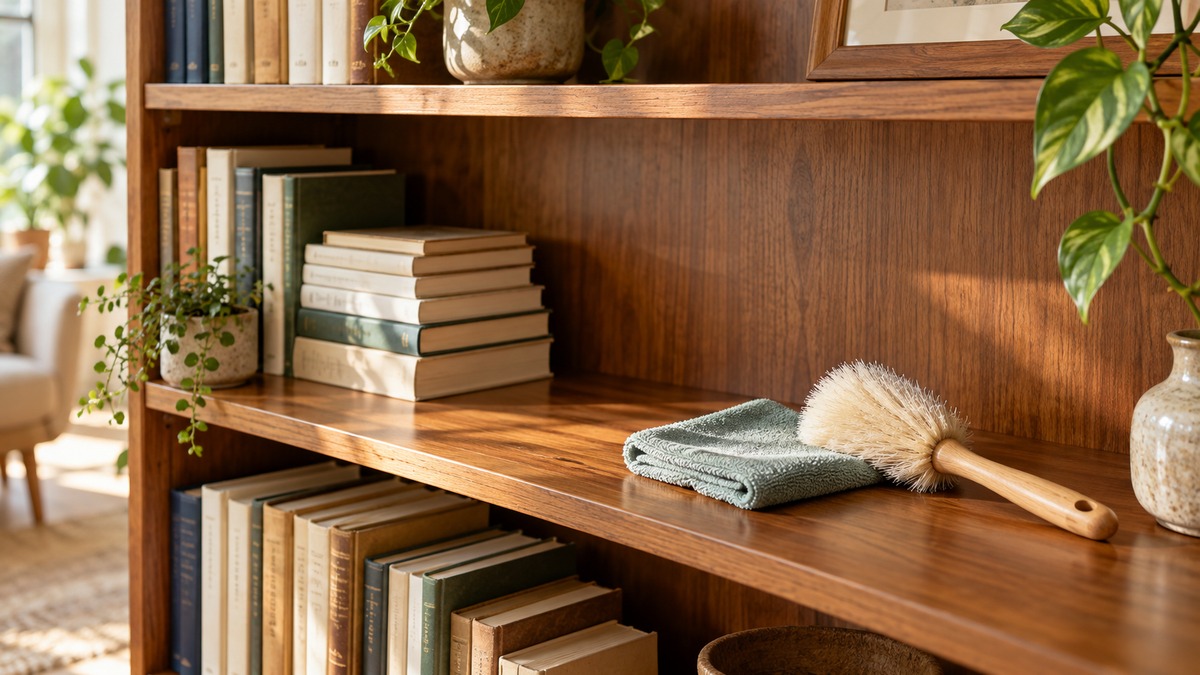
How to clean a bookshelf starts with dust, because dust is what the preservation guides address most directly. The Library of Congress, the State Library of Queensland and the National Park Service all treat dust on shelves and books as a care issue, and their methods agree on the basics: use a duster without fragrance or chemicals, use a vacuum with a soft brush where you can, and keep feather dusters out of the job. This guide sets out those steps and shows the surface arithmetic for a five-shelf unit.
Quick answer
- Dust the shelves and books with a duster that has no fragrance or other chemicals, as the Library of Congress guide says.
- On wood surfaces, use a vacuum with a soft bristled brush held at least 1/2 inch away.
- Do not use feather dusters, because broken feathers may scratch the surface.
- Clean the shelves and the books on a regular basis, not only when the shelf looks dirty.
Start with the right duster
The Library of Congress research guide gives the basic rule for a shelf and its books: “Dust books and shelves with dusters that do not contain any fragrances or other chemicals.” The Library of Congress FAQ on books uses the same idea and names one type of tool: “Dust books and shelves with “magnetic” dusters that do not contain any fragrances or other chemicals.” Either way, the choice is the same. The duster should not add a scent or a chemical to the shelf or to the books on it.
The pages we opened do not name a brand of duster or give a cleaning product for a bookshelf finish. If you are unsure whether a product has fragrance or chemicals in it, the rule above tells you to pick another duster. That is a practical choice, not a product recommendation.
Vacuum the wood, and keep the brush soft
For wood surfaces, the National Park Service guidance for wooden objects is the closest source we opened. It is written for museum collections rather than home furniture, but its dusting rules are specific. It says: “Use a vacuum to remove the dust from wood surfaces if possible.” It also gives the method: “Dust these surfaces gently with a soft bristled brush and a low power vacuum held at least 1/2 inch away.”
The distance is the detail to keep. A brush held against the wood can scrape the finish, while a brush held a half inch away lifts the dust without touching the surface. If the brush you own is stiff, the sources do not describe a safe alternative, so use the softest brush head you have and test a small spot first.
Leave out feather dusters
Feather dusters are the tool most often used on shelves, and the National Park Service guidance rules them out. It says: “Don’t use feather dusters.” It gives the reason in one short line: “Broken feathers may scratch the surface.” A bookshelf finish is a surface, so the same concern applies. Put the feather duster away and use a cloth or a vacuum brush instead.
Clean the books as well as the shelf
Dusting the shelf alone is not the whole job. The State Library of Queensland guide says: “Thorough cleaning of shelves and books on a regular basis will also assist in minimising build-up of harmful particulate matter and pest activity.” It makes the same point in shorter form: “To minimise pest and mould activity, keep books and shelving free of dust and dirt.” Clean the spines and the top edges of the books when you clean the shelf below them.
The Queensland guide also explains why dust is more than a visual problem. It notes that dust “can settle on shelves and books and create dust that can abrade materials when handled.” Dust that is still on a book when you pull it out is more likely to rub the cover, so it is worth clearing both the shelf and the books on each session.
Check the shelf before you clean it
Look at the shelf as you clean it. The Library of Congress guide sets a basic condition: “All shelves should be completely flat and not have any protrusions such as splinters or nails.” A shelf with a rough or lifted edge is easy to spot while you work, and a book can snag on it. If you find one, note it and deal with it before you put books back.
The sources we opened do not say how to repair a damaged shelf, so this guide does not give a repair method. If a shelf is splintered or has nails showing, the Library of Congress condition is the test to apply, and the repair is a separate job.
Measure the surface you are cleaning
Dusting takes longer on a deep unit with many shelves, because each shelf adds a top surface to clear. The table works out the top surface of a sample five-shelf unit. The width and depth are our assumptions, not figures from the sources, so replace them with the measurements of your own unit.
| Surface | Shelves | Width (inches, assumed) | Depth (inches, assumed) | Top area (square inches) |
|---|---|---|---|---|
| Shelf tops, one shelf | 1 | 30 | 10 | 30 × 10 = 300 |
| Shelf tops, whole unit | 5 | 30 | 10 | 5 × 300 = 1,500 |
| Whole unit in square feet | 5 | 30 | 10 | 1,500 ÷ 144 = 10.4 |
The result is about 10.4 square feet of shelf top for one unit. That number does not include the books, which have their own surfaces to clean, and it does not include the sides or the back. The sources do not give a cleaning time or a schedule, so the arithmetic tells you how much area to plan for, not how long each session will take.
A simple order for each cleaning session
Use the same order each time, so nothing gets missed. Start with the empty shelf: check that it is flat, as the Library of Congress guide requires. Dust the shelf with a non-chemical duster, and vacuum any wood surface with a soft brush held at least half an inch away. Then take the books off in small groups, clean their tops and spines, and return them to the shelf.
The order matters because the shelf is clean before the books go back on it. The sources do not say how long to leave a shelf between cleanings, so choose an interval you can keep, and clean sooner if you see dust building up on the shelf or on the books.
If you are still choosing the unit, the comparison of Furinno and Sweetcrispy bookcases compared shows two units on the same kind of measurements, and VASAGLE and Sweetcrispy bookcases compared covers another pairing. Count the shelf tops before you choose, because each one adds to the cleaning area in the table.
Keep dust and humidity steady
Dust is easier to manage when the room is steady. The State Library of Queensland guide acknowledges that stable conditions are hard to reach without climate control, and it lists simple steps. It says: “Prevent dramatic fluctuations in temperature and humidity.” It also says: “External walls are subject to much greater daily fluctuations in temperature and humidity than internal walls.” The same guide’s placement rule follows: “Avoid placing bookshelves on external walls.”
For a narrow room where an inside wall is the only option, see bookshelves for a small room. For a mini room, see bookshelves for mini rooms, and for a dorm room, see dorm room bookshelves.
Set a light level for the wood
Light is the other factor the sources name. The National Park Service guidance for wooden objects gives a number for finished wood in museum settings: “The light level for most finished wood objects should not exceed 200 lux.” That figure is a museum target, not a home standard, and the pages we opened do not explain how to measure lux at home. Use it as a reason to keep a finished bookshelf out of direct sun, not as a meter reading you need to hit.
The Library of Congress storing guide gives the same direction for books: “Light Levels: Books should have minimal exposure to all kinds of light and ideally no exposure to direct or intense light.” If a unit sits in a sunny window, move it before you start a cleaning routine, because cleaning does not change how much light reaches the books.
Count the surfaces before you buy
A unit with fewer shelves has less top area to clear, and that matters as much as how the unit looks. For readers still deciding on size, living room bookshelves for an apartment and bookcase ideas for small rooms cover the choice from the room side. For a comparison of two units on the same measurements, see Sweetcrispy and IRONCK bookcases compared. For another pairing, see VASAGLE and IRONCK bookcases compared, and for a third, see Furinno and IRONCK bookcases compared.
How we chose
This is a cleaning method, not a product list. We chose the cleaning rules that appear in the pages we opened on 2026-10-21: a Library of Congress research guide on storing books, a Library of Congress FAQ on books, a State Library of Queensland guide on caring for book collections, and a National Park Service appendix on caring for wooden objects. We kept only rules that one of these pages states in plain words, and we checked every quoted sentence against the text of the page it came from. The surface figures are our arithmetic, and each assumption is named.
Mistakes to avoid
- Using a feather duster. The National Park Service guidance says not to, because broken feathers may scratch the surface.
- Using a fragranced or chemical duster. The Library of Congress guide asks for dusters that do not contain fragrances or other chemicals.
- Holding the vacuum brush against the wood. The same guidance asks for a soft brush held at least 1/2 inch away.
- Dusting the shelf but not the books. The State Library of Queensland guide asks for both to be cleaned.
- Pulling books out by the top of the spine. The Queensland guide warns that this damages books, and it is easier to do during a clean-out.
What we could not verify
The pages we opened do not give a cleaning schedule, a method for wet cleaning a bookshelf, or a product for a wood finish. The National Park Service guidance is for museum wooden objects and collections staff, so it is a close fit for a home shelf rather than an exact one. We did not test any cleaner, duster or vacuum, and we do not claim that any product is safe for a particular finish. The table’s width and depth are assumptions, and the sources do not give the surface area of any bookcase.
Frequently asked questions
What is the best way to dust a bookshelf?
Use a duster that has no fragrance or other chemicals, as the Library of Congress guide says. On wood surfaces, the National Park Service guidance suggests a vacuum with a soft bristled brush held at least 1/2 inch away.
Can I use a feather duster on bookshelves?
The National Park Service guidance says not to. It states: “Don’t use feather dusters.” It adds that broken feathers may scratch the surface.
Should I clean the books or only the shelf?
Both. The State Library of Queensland guide says thorough cleaning of shelves and books on a regular basis helps limit harmful particulate matter and pest activity.
Are scented sprays safe to use near books?
The Library of Congress guide asks for dusters without fragrances or other chemicals. The pages we opened do not address sprays, so we do not give a rule for them. Choosing a fragrance-free, chemical-free duster follows the guide.
How often should I clean a bookshelf?
The sources we opened do not give a schedule. The Queensland guide calls for regular cleaning, so pick an interval you can keep and clean sooner if dust builds up on the shelf or the books.
Bottom line
Dust the shelf and the books with a fragrance-free, chemical-free duster, and vacuum wood with a soft brush held at least half an inch away.
Sources
- https://guides.loc.gov/preserving-your-books/storing (opened 2026-10-21)
- https://www.loc.gov/preservation/about/faqs/books.html (opened 2026-10-21)
- https://www.slq.qld.gov.au/sites/default/files/Caring%20for%20your%20collections%20-%20Books%20%26%20bound%20material_2025.pdf (opened 2026-10-21)
- https://www.nps.gov/subjects/museums/upload/MHI_AppN_WoodObjects.pdf (opened 2026-10-21)
As an Amazon Associate we earn from qualifying purchases.