How to Store Books in Boxes
As an Amazon Associate we earn from qualifying purchases.
How to store books in boxes comes down to three decisions: whether each book can stand upright, how the books sit inside the box, and what the box is for. The National Park Service and the Library of Congress give clear packing rules, and the State Library of Queensland explains when a box is worth the space. This guide turns those rules into a packing plan, a check before you close the box, and a count of books per box, so you know how many boxes a collection needs before you buy them.
Quick answer
- Books that are not oversize, fragile or heavy can stand upright on their bottom edge in the box, according to the National Park Service sheet.
- Pack heavier and larger volumes at the bottom of the box, or pack the books vertically, spine down.
- Place volumes spine down, next to materials of similar size, as the Library of Congress scrapbook guide says.
- Use archival storage boxes for valuable books where outdoor air is polluted, such as near busy roads, according to the Queensland guide.
What the box is for
A box is one way to store a book, and it does not replace the shelf or the room. The State Library of Queensland guide puts the box in context. It says that small and medium sized volumes in good condition “may be stored either upright on shelves or within folders or boxes.” A box is one option among several, not a requirement for every book.
The same guide gives a reason to box valuable books in some homes. Where a home sits near “busy roads and industrialised areas,” it says to “place valuable books in archival storage boxes to prevent particulate matter from settling on the books.” If your home is not in that kind of area, the boxing rule is a choice rather than a need, and the shelf may serve well.
Pack the books upright or flat
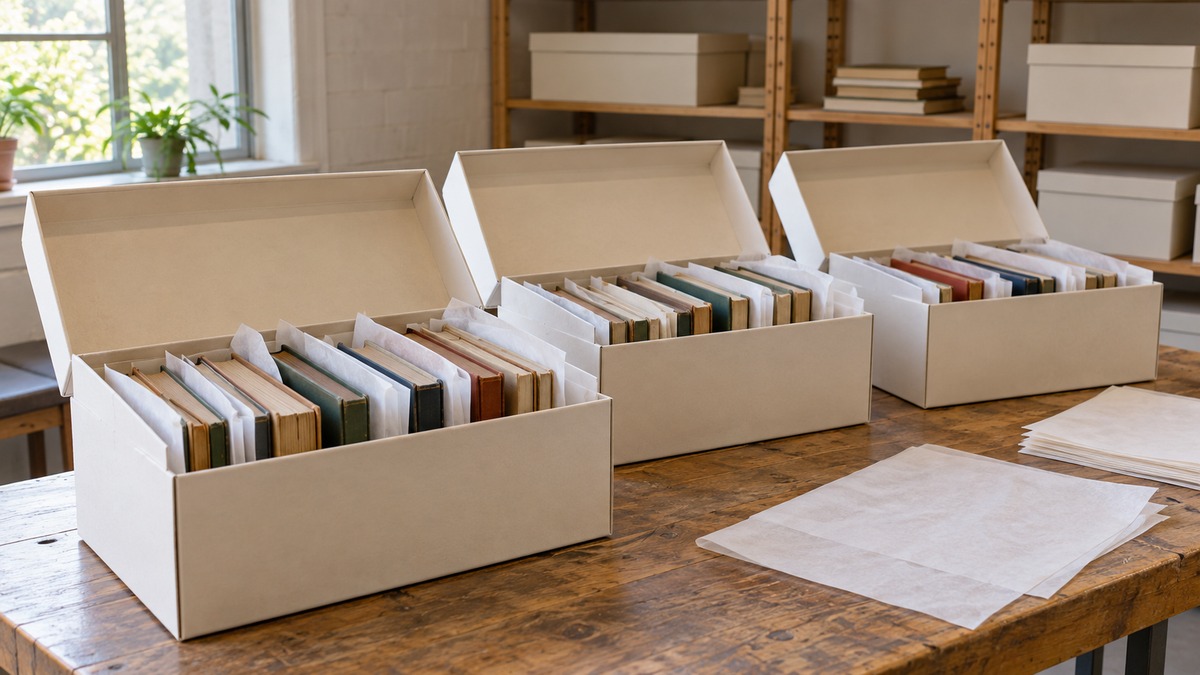
Most books in a box can stand, and the National Park Service sheet on bound archival materials gives the rule for them: “House boxed books that are not oversize, fragile, or heavy, upright on their bottom edge on the shelving.” The phrase covers two conditions, the book’s size and its condition. A book that is oversize, fragile or heavy is outside the rule, and it should be packed flat instead.
The Library of Congress FAQ on books gives the packing choice in one sentence: “Pack books flat in the box with heavier and larger volumes at the bottom or pack books vertically, spine down.” Flat packing suits books that are too wide or too heavy to stand, and vertical packing suits the rest. Choose one method for a box, so the books sit evenly and do not lean in mixed directions.
For a dorm room where boxes share a shelf with upright books, see dorm room bookshelves. For a small room, see bookshelves for a small room.
Heavier and larger volumes go low
The packing rule for weight is direct: “heavier and larger volumes at the bottom.” In a box, the bottom is the part that carries the load of everything above it. Put the largest and heaviest volumes at the bottom, then pack lighter books above them, and check that the top books do not press on fragile covers.
The sources we opened state the rule for heavier and larger volumes, but they do not explain what happens when a lighter book sits beneath a heavy one, so we add no reason of our own. Follow the rule as written, and when a box mixes weights, keep the heaviest volumes in the bottom layer.
Keep neighbors of similar size
The Library of Congress scrapbook guide gives the spine direction and the matching rule in one sentence: “Volumes in boxes should be stored spine down, adjacent to materials of similar size.” The sentence asks for two things: spine down, and neighbors of similar size. Each part is a rule the guide states, and we add no reason beyond it.
For a box with mixed sizes, sort the books into groups before you pack. A group of small volumes in one box, a group of medium volumes in another, and the largest volumes packed flat in their own box give the cleanest result.
Count the books per box
The count depends on the inside width of the box and the spine width of the books. The sources do not give a box size or a spine width, so the table uses assumed figures. Replace them with the inside width of your box and the spine widths of your books before you buy.
| Box inside width (inches, assumed) | Spine width (inches, assumed) | Books that fit: width ÷ spine, rounded down | Room left (inches) |
|---|---|---|---|
| 12 | 1.25 | 12 ÷ 1.25 = 9.6, so 9 | 12 − (9 × 1.25) = 0.75 |
| 12 | 1.50 | 12 ÷ 1.50 = 8.0, so 8 | 12 − (8 × 1.50) = 0.00 |
| 14 | 1.25 | 14 ÷ 1.25 = 11.2, so 11 | 14 − (11 × 1.25) = 0.25 |
The room-left column is the important one. A box with 0.00 inches left is full edge to edge, which is the packing the sources warn against on shelves, so leave some room or use a wider box. The sources do not give a buffer size for boxes, so the choice of how much room to keep is yours.
For a closet where the boxes will be stored, see closet organizing ideas for small spaces. For storage in a home without a closet, see storage ideas for a house with no closets.
Check the box before you close it
A closed box hides problems, so check each one before the lid goes on. The National Park Service sheet describes archival boxes that hold books “vertically upright in archival boxes with no leaning.” Look for books that lean against the lid or the side, because a leaning book is out of the position the sheet describes.
Check that the heaviest books are at the bottom, that the spines face the same way, and that the sizes match within each box. If a box is too full to close without pressing on the books, take a book out and move it to another box or to a shelf.
Decide between a box and a shelf
A box and a shelf both work for books in good condition. The Queensland guide gives the choice in one line: “Small and medium sized volumes in good condition may be stored either upright on shelves or within folders or boxes.” The box earns its space for valuable books, for books in a home near polluted outdoor air, and for oversize or fragile volumes that should not stand on a shelf.
For books you read often, a shelf keeps them in reach. For books you keep for long periods, a box keeps them out of the way. Many collections use both, and the rules above apply to each part of the collection in the same way. To compare two bookcases that could hold the shelf part, see Furinno and Sweetcrispy bookcases compared, or VASAGLE and IRONCK bookcases compared. For a living room unit, see living room bookshelves for an apartment. For a mini room, see bookshelves for mini rooms, and for a nook or corner, see bookcase ideas for small rooms.
Choose the box
The pages we opened use the term archival for storage boxes, but none of them defines the term or describes a box material or a box grade. Look for the word archival in a seller’s description, and check that the box’s inside size holds the book with room to spare. Ask the seller what the term means before you buy, because the sources do not settle it for you.
Measure the book’s full height, width and thickness before you choose a box. A box that is only a little larger than the book leaves no room for the books to be taken out without forcing them, which is the packing problem the sources raise for shelves.
Plan the number of boxes
Once you have a books-per-box count, the number of boxes follows. Suppose a collection has 300 books, and the table’s first row gives 9 books per box. Then 300 ÷ 9 = 33.3, which rounds up to 34 boxes. If the books are wider and the count drops to 8 per box, the same collection needs 300 ÷ 8 = 37.5, which rounds up to 38 boxes. The collection size is our example, not a source figure.
Mixed sizes change the count, so sort first and count each group separately. Round each group up to whole boxes, since a partly filled box still needs its own space. For a closet layout that can hold the boxes, see small walk-in closet ideas on a budget.
How we chose
This is a packing method, not a product list. We chose the rules that appear in the four pages we opened on 2026-10-21: a National Park Service sheet on bound archival materials, a Library of Congress FAQ on books, a State Library of Queensland guide on caring for book collections, and a Library of Congress care page on scrapbooks and albums. We kept only rules that one of these pages states in plain words, and we checked every quoted sentence against the text of the page it came from. The box counts are our own arithmetic, and the box and spine figures are named as assumptions.
Mistakes to avoid
- Standing an oversize, fragile or heavy book upright in a box. The National Park Service sheet limits the upright rule to books that are not oversize, fragile or heavy.
- Putting heavy books on top. The Library of Congress FAQ says to pack heavier and larger volumes at the bottom.
- Mixing spine directions. The Library of Congress scrapbook guide says volumes in boxes should be stored spine down.
- Packing a box to the edge. The table shows that a full-width box leaves no room, and the sources warn against tight packing on shelves.
- Boxing every book without a reason. The Queensland guide gives boxes as one option, and its reason for valuable books is tied to outdoor air.
What we could not verify
The pages we opened do not give a box size, a box material beyond “archival”, a book count per box, or a buffer for room left in a box. They do not give the height at which a book counts as oversize, or a weight at which a book counts as heavy. The National Park Service text we opened is written for archival and rare materials, so its packing rules are a close fit for a home rather than an exact one. We did not test any box, and nothing in this guide is a product claim.
Frequently asked questions
Should I store books in boxes or on a shelf?
Both can work. The State Library of Queensland guide says small and medium sized volumes in good condition may be stored upright on shelves or within folders or boxes. Boxes suit valuable books and books in a home near polluted outdoor air, and shelves suit books you read often.
Can I stand books upright in a box?
Yes, if they are not oversize, fragile or heavy. The National Park Service sheet says boxed books that are not oversize, fragile or heavy can stand upright on their bottom edge. Flat packing is the rule for the rest.
How many books fit in a box?
Divide the inside width of the box by the spine width of your books, and round down. The sources do not give either figure, so use your own measurements. The table in this guide shows the arithmetic.
Which books should go at the bottom of a box?
The heavier and larger volumes. The Library of Congress FAQ says to pack heavier and larger volumes at the bottom of the box, or to pack books vertically, spine down.
Do valuable books need archival boxes?
The State Library of Queensland guide says, for homes near busy roads and industrialised areas, to place valuable books in archival storage boxes to prevent particulate matter from settling on the books. The guide does not say every book needs a box.
Bottom line
Pack books that are not oversize, fragile or heavy upright, put heavier and larger volumes at the bottom, and leave room in every box.
Sources
- https://www.nps.gov/subjects/museums/upload/19-18_508.pdf (opened 2026-10-21)
- https://www.loc.gov/preservation/about/faqs/books.html (opened 2026-10-21)
- https://www.slq.qld.gov.au/sites/default/files/Caring%20for%20your%20collections%20-%20Books%20%26%20bound%20material_2025.pdf (opened 2026-10-21)
- https://www.loc.gov/preservation/care/scrapbk.html (opened 2026-10-21)
As an Amazon Associate we earn from qualifying purchases.