How to Organize Garage Shelves
Affiliate disclosure: As an Amazon Associate we earn from qualifying purchases.
How to organize garage shelves starts with where the heavy items go, not with the bins or the labels. The UBC lifting guideline places heavy objects between the mid-thigh and the waist, and keeps lighter items above the shoulder or below the knee. The consumer safety commission adds two rules: store heavier items on lower shelves, and anchor tall furniture to the wall. This guide turns those rules into a zone map, a height table in feet and inches, and a checklist for the shelves you already own.
Quick answer
- Put the heaviest items on the lower shelves. The commission says to “Store heavier items on lower shelves, or in lower drawers.”
- Keep heavy items between mid-thigh and waist height, which the UBC lifting guideline calls the strongest lifting zone.
- Store only lighter items above shoulder level or below knee level, as the same guideline advises.
- Anchor any tall unit to the wall, because the commission’s guidance says to anchor bookcases and dressers.
Start with the heavy items
The Washington State guide hosted on CDC Stacks is titled “organize and store heavy objects at a comfortable height.” It is a workplace document from 2008, so read it as a general lifting rule rather than a garage standard. It states the injury risk this way: injuries “can occur when” workers “must reach or lift heavy objects from the ground or from far away from the body.” Its prevention list begins with a simple instruction: “Provide storage locations and racks for equipment and materials.”
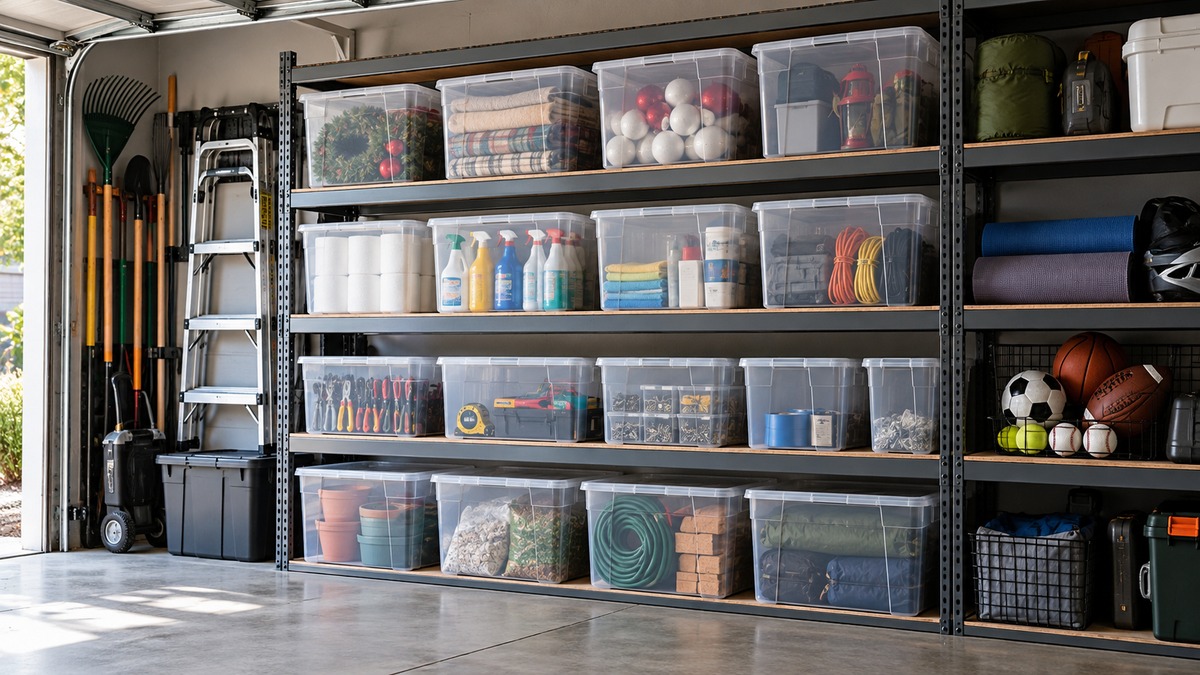
Put the heavy items in the zone where lifting is easiest, and keep them off the floor and out of overhead reach. The commission’s wording is short: “Store heavier items on lower shelves, or in lower drawers.” That rule and the lifting guideline agree on the direction, even though they come from different kinds of documents. Read together, they give a simple check for each item: can it be lifted from a comfortable height, close to the body? If not, it belongs in a different zone.
Map the lifting zones
The UBC Lifting Guidelines are a university human resources document. It sorts a shelf by lifting zone, and it gives two rules about light items. The table keeps the document’s wording for each zone and marks the bands it does not describe.
| Zone | What the UBC guideline says | What it means for your garage |
|---|---|---|
| Above shoulder level | Store only lighter items above shoulder level | Light, rarely used items, such as seasonal decorations |
| Waist to shoulder | Not described in the document | Medium items you reach often, if they are not heavy |
| Mid-thigh to waist | Strongest lifting zone: between mid-thigh and waist height | The heaviest items you lift regularly |
| Knee to mid-thigh | Not described in the document | Items that need a lift but are not the heaviest |
| Below knee level | Store only lighter items below knee level | Light, bulky items, such as bags or soft goods |
Two bands are open. The document does not describe the band from waist to shoulder or the band from knee to mid-thigh, so this guide does not assign rules to them. For those bands, the decision is yours, and the examples in the last column are suggestions, not findings from the source.
The zone map is a sorting tool, not a shelf plan. It does not tell you how many shelves to build, and none of the sources gives a shelf count for a garage. Decide the count from the items you own and the wall space you have, then check each shelf against the zone it falls in.
Convert the reach figures to feet
Garage shelves need heights in inches and feet. The shelf guides in this guide use inches, so convert each figure by dividing by 12. Woodbin’s shelf guide gives two reach figures that can help set the top and bottom of a unit. It says “The lowest shelf should be 3 to 4 inches from the floor level,” and for the top it gives “about 72 to 78 inches” for an average-sized person.
| Figure | Inches | Feet (inches divided by 12) | Source and note |
|---|---|---|---|
| Lowest shelf from the floor, low end | 3 | 0.25 | Woodbin; bookcase guide |
| Lowest shelf from the floor, high end | 4 | 0.33 | Woodbin; bookcase guide |
| Highest comfortable shelf, low end | 72 | 6.0 | Woodbin; average-sized person |
| Highest comfortable shelf, high end | 78 | 6.5 | Woodbin; average-sized person |
Woodbin’s figures describe bookcases, not garage racks. They give a rough line for the top of a reachable zone, but the sources do not set that line for garage shelves. Measure the shoulder and waist heights of the people who will use the shelves before you fix the zones in inches.
Place items near where they are used
The CDC Stacks document lists storage as a prevention step, and it adds a placement step: “Place the equipment as close as possible to the location of use.” In a garage, that means the tools for a bench sit near the bench, and the items for the car sit near the door you use to leave. The document does not describe a garage, so treat the placement step as a principle that fits a workspace.
Reach matters at the top of a unit too. Woodbin’s shelf guide says that “If the shelves will be accessed from a sitting position, the highest shelf should be no more than 60 inches above the floor.” If a stool or a seat is part of your routine in the garage, use that 60-inch limit for the highest shelf you load often, and keep the heaviest items in the zone between mid-thigh and waist height.
Plan the rows before you buy
A garage plan works better when the heavy items are settled first. Sort the things you own into three groups: heavy, medium and light. Then assign the heavy group to the zone between mid-thigh and waist height, the light group to the zones above shoulder and below knee, and the medium group to the open bands. Each step is a method you choose, not a finding from the sources.
For shelf choices, the Sakugi vs SONGMICS utility shelves page and the Sakugi vs MaxWorks utility shelves page each compare one pair of units. The OUTNILI vs Sttoraboks storage racks page covers a third pair. Use those pages to check what each listing states about its own shelves before you map the zones.
Anchor a tall unit to the wall
A tall garage unit can tip, so the zone plan is not the whole job. The Consumer Product Safety Commission’s 2022 news release says to “Anchor TVs and furniture, such as bookcases and dressers, securely to the wall.” The Anchor It! site says that “Anchoring all furniture with drawers, doors, and shelves to the wall prevents tip-over injuries and deaths”.
The sources do not name the anchor hardware, the number of anchors or the wall material that suits a garage. Choose the anchoring method for the unit you buy, and follow its instructions for the wall that will carry it. The Plano vs VEVOR standing shelf units page and the SINGAYE vs VEVOR standing shelf units page are two standing-unit comparisons to read before you choose a unit.
Metal racks and overhead storage
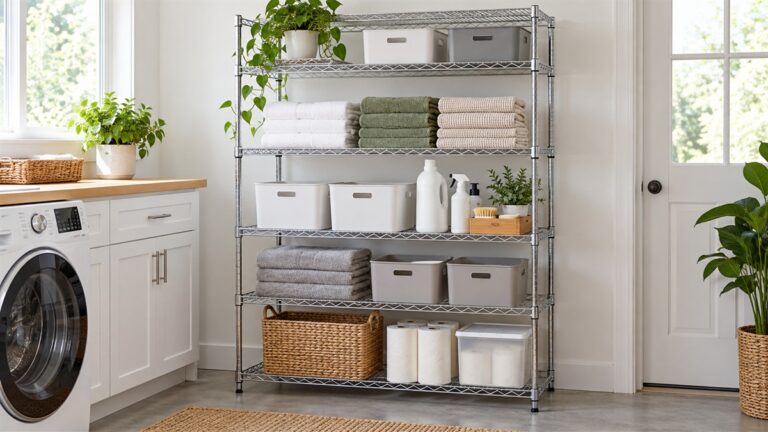
Metal racks suit heavy items, but a rack is only as useful as its placement. If you are comparing a metal rack, the Hyper Tough 5-shelf metal storage rack and the HOMEDANT 5-tier metal shelving pages are two product pages to read. Put heavy items in the mid-thigh to waist band of the rack, not on its top tier, and check that the rack is anchored before you load it.
If the garage has overhead space, that is a different storage type. The ceiling mounted storage racks compared page covers one pair, and the HYLOFT 45 x 45 ceiling storage unit page covers a single product. Any shelf above shoulder level should hold only lighter items, as the UBC guideline advises.
Buying checklist
- List the heavy, medium and light items you own, and count them by group before you pick a unit.
- Assign the heavy group to the band between mid-thigh and waist height on the shelf you plan to fill.
- Keep the lowest shelf and the highest shelf within the reach figures from Woodbin, converted to feet.
- Read the outside size and the load rating on the listing for the unit, since the sources give none.
- Find the anchoring instructions for the wall before the unit arrives.
How we chose
We chose the sources because each speaks to one part of the plan. The CDC Stacks document gives the workplace rule for heavy items. The UBC guideline gives the lifting zones and the light-item rules. The commission gives the placement rule and the anchoring instruction, and Woodbin gives the bookcase reach figures. The Anchor It! page confirms the anchoring instruction at the source agency. Every quotation was matched against the fetched text of its page on 2026-10-21.
Mistakes to avoid
- Storing heavy paint or tools above shoulder level. The UBC guideline keeps that band for lighter items only.
- Putting the heaviest items on the top tier of a rack. The commission says to store heavier items on lower shelves or in lower drawers.
- Sorting by appearance instead of weight. The lifting zones are about the load, not the look of the bin.
- Leaving a tall unit unanchored. The commission’s guidance covers bookcases and similar furniture.
- Treating overhead space as general storage. The UBC guideline limits what goes above shoulder level to lighter items.
What we could not verify
- The sources do not convert the knee, mid-thigh, waist and shoulder bands into inches for any person. Measure them on the people who will use the shelves.
- The CDC Stacks document is dated 2008 and describes a Washington State workplace guide, not a home garage.
- The UBC document is a university human resources guideline, not a shelving standard.
- No source gives a load rating for garage shelves, so this guide gives none. Read the rating on the listing for the unit you choose.
- The Woodbin reach figures describe bookcases. They are a reference for garage shelves, not a finding about them.
- No source describes how a garage is used, how often items move, or how many people reach a shelf. Those are decisions for the person who sets up the space.
FAQ
Where should heavy items go on garage shelves?
Put them on the lower shelves, or in lower drawers, as the commission advises. The UBC guideline places the strongest lifting zone between mid-thigh and waist height, so heavy items belong in that band when you can.
What is the strongest lifting zone?
The UBC Lifting Guidelines place the strongest lifting zone between mid-thigh and waist height. The document says to store heavier items there.
Can I store light items above shoulder height?
Yes. The UBC guideline says to store only lighter items above shoulder level. Keep heavy items out of that band.
Do I need to anchor a garage shelf unit?
The commission’s 2022 news release says to anchor bookcases and dressers securely to the wall, and the Anchor It! site makes the same point for furniture with shelves. The sources we opened do not name the hardware, so follow the unit’s instructions.
How high should the top shelf be?
Woodbin’s bookcase guide puts the highest comfortable shelf at about 72 to 78 inches for an average-sized person. Measure the people who will use the shelf before you fix the height.
How do I start if I have no height figures?
Sort your items into heavy, medium and light groups, then assign the heavy group to the mid-thigh to waist band. Measure the bands on your own users before you mark the shelves.
Bottom line
Put the heaviest items between mid-thigh and waist height, keep only lighter items above shoulder level or below knee level, and anchor any tall unit to the wall before you load it.
Sources
- Washington State Department of Labor and Industries, “If you have to move it manually – organize and store heavy objects at a comfortable height,” CDC Stacks: https://stacks.cdc.gov/view/cdc/200345 (opened 2026-10-21)
- UBC Human Resources, Lifting Guidelines (PDF): https://hr.ubc.ca/sites/default/files/2020-09/Lifting%20Guidelines.pdf (opened 2026-10-21)
- U.S. Consumer Product Safety Commission, 2022 news release on anchoring TVs and furniture: https://cpsc.gov/Newsroom/News-Releases/2022/CPSC-Injury-and-Fatality-Report-Shows-Despite-Some-Progress-Need-for-TV-and-Furniture-Tip-Over-Prevention-Remains-Strong (opened 2026-10-21)
- Anchor It! campaign, U.S. Consumer Product Safety Commission: https://www.anchorit.gov/ (opened 2026-10-21)
- Woodbin, shelf design guidelines: https://woodbin.com/?p=1129 (opened 2026-10-21)
As an Amazon Associate we earn from qualifying purchases.